
Italian Orange Soufflé | Soufflé all'Arancia

A soufflé all'arancia is a sweet orange custard, whipped egg white and nothing else. There is no gelatin holding it up and no scaffolding of flour heavy enough to matter. What lifts it is steam, and steam only behaves if the oven is left completely alone.
This version scents the base with orange zest and Aurum, the Abruzzese orange liqueur, bakes in the lower third of a static oven and reaches the table inside a minute.
Yield: 4 soufflés. Prep: 25 minutes. Chill: 20 minutes. Bake: 14 minutes. Total: about 1 hour. Difficulty: advanced. Course: dolce. Region: Italy, by way of Turin, Naples and the citrus of Sicily.
The Story
The soufflé is not an Italian invention and no Italian cook pretends otherwise. It was codified in France, refined in the early nineteenth century by Antonin Carême, and it arrived in Italy the way most grand French pastry did: through aristocratic kitchens that employed French trained cooks. In Naples those cooks were called monsù, a local flattening of monsieur, and they ran the households of the Bourbon nobility for generations. In Turin the route was the Savoy court, which spoke French at table long before it ruled a unified Italy.
Pellegrino Artusi put the dish into Italian hands in 1891. La Scienza in Cucina e l'Arte di Mangiar Bene calls it soffiato, the blown thing, and gives versions built on rice, on chestnut and on potato flour. Artusi was writing for the domestic kitchens of the new middle class, and the fact that he bothered to translate the name tells you the technique had already escaped the palaces. From there it settled into the repertoire of Italian pastry as one more thing a competent cook was expected to manage.
The orange is what makes this one Italian rather than borrowed. Sicily grows the blood oranges of the Catania plain, Tarocco, Moro and Sanguinello, on volcanic soil below Etna, and Calabria grows sweet oranges along the Ionian coast. Aurum, the liqueur that flavours the base here, was created in Pescara in 1925 by Amedeo Pomilio, who macerated Abruzzese orange peel in brandy and gave the result a Latin name. Put those two things into a French technique and the dish stops being a quotation.
What kept the soufflé alive in Italy was the restaurant rather than the home. It belongs to the family of dolci al cucchiaio, the spoon desserts, and unlike a panna cotta or a tiramisu it cannot be made in the morning and held. That makes it useless to a home cook feeding a table and valuable to a dining room, which is why Italian waiters still ask for the soufflé order at the beginning of the meal rather than the end. The kitchen needs the warning. Ordering it is a small piece of theatre that both sides agree to, and it has survived unchanged for well over a century because the physics of the dish leaves no alternative.
Ingredients
Quantities are for four straight sided porcelain ramekins of 6 fl oz (180 ml) each. Weigh the whites rather than counting them.
For the ramekins
Unsalted butter, very soft, 1 1/2 tbsp (21 g)
Caster sugar, for coating, 3 tbsp (38 g)
For the orange base
Whole milk, 3/4 cup (180 ml)
Finely grated orange zest, from 2 large oranges
Egg yolks, large, 3
Caster sugar, 1/4 cup (50 g)
Cornstarch, 2 tbsp (16 g)
Unsalted butter, 1 tbsp (14 g)
Aurum or another Italian orange liqueur, 1 1/2 tbsp (22 ml)
Fine sea salt, 1 small pinch
For the meringue
Egg whites, at room temperature, 6 oz (170 g), about 5 whites
Caster sugar, 3 tbsp (38 g)
Cream of tartar, 1/4 tsp (0.8 g)
For finishing
Powdered sugar, for dusting, 2 tsp (5 g)
Candied orange peel, finely diced, 1 tbsp (12 g), optional
Preparation
Coat and chill the ramekins
Take the butter out well ahead so it spreads rather than smears. Coat the inside of each ramekin completely, floor and walls both, leaving no bare porcelain anywhere. Spoon in caster sugar, rotate the dish until the sugar has taken everywhere, then tip the excess into the next ramekin and carry on. Put all four in the refrigerator until the moment you fill them, so the butter is firm and the sugar shell stays where you put it.
Infuse the milk with orange zest
Grate the zest of both oranges straight into a small saucepan with the milk. Bring it to the edge of a simmer, pull it off the heat, cover it and leave it 10 minutes. This gentle infusion pulls far more perfume into the milk than grating zest into a finished base ever will. Strain through a fine mesh sieve and press the zest with a ladle to recover what it holds.
Cook the orange base
Whisk the yolks with the sugar until pale, then whisk in the cornstarch and the pinch of salt until no dry streaks remain. Pour in the warm milk in a thin stream, whisking constantly, and return everything to the saucepan over medium heat. Whisk without stopping until the mixture thickens and gives up two or three slow bubbles, about 2 minutes, then cook 30 seconds more to take the raw starch taste away. Off the heat, beat in the butter and the Aurum. The base should fall from the whisk in a thick ribbon. Cover it and hold it warm.
Bring the oven to a genuine temperature
Set a solid baking tray on the rack in the lower third of the oven, set the oven to 375°F (190°C) on static heat with no fan, and give it a full 20 minutes after the indicator light goes out. An oven that has only just reached its set point has hot air and cold walls and cold shelves, and that stored heat is what carries the soufflé through the first minutes. If your oven has a fan setting, leave it off. Do not put the tray in later: it must be as hot as the oven itself.
Whip the whites and fold
Start the whites with the cream of tartar at medium speed until they turn opaque and foamy, then rain in the caster sugar in three goes and raise the speed. Stop at a medium peak, the point where the tip of a lifted whisk curls over instead of standing upright. Whites taken further look impressive and behave badly. Fold them into the warm base in three additions with a large spatula, cutting down through the centre, turning the bowl a quarter each pass and stopping the second the streaks disappear.
Fill, bake and keep the door shut
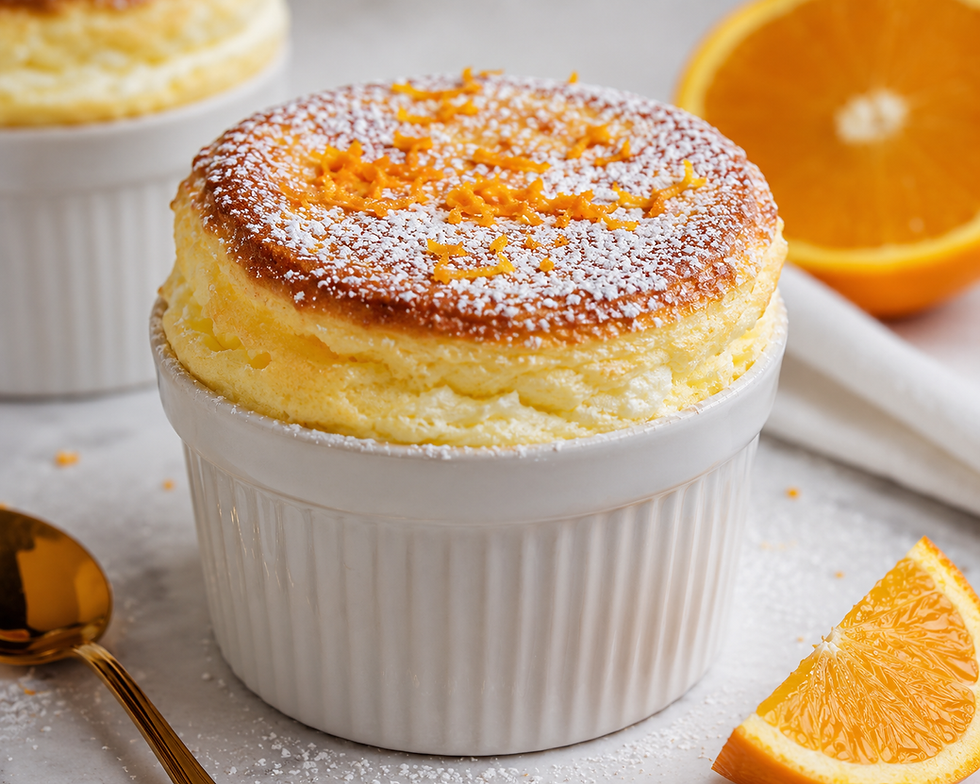
Fill each chilled ramekin to the very rim and level the top with a palette knife in one pass. Run a clean thumb around the inside edge to clear the rim. Open the oven once, set the ramekins on the preheated tray, close it and leave it closed for 14 minutes. Watch through the glass only. They are ready when they stand about 1 1/2 inches (4 cm) above the rim, the crown is deep gold and the whole thing trembles as one piece when the tray is nudged.
Plating
Plating a soufflé is a matter of seconds, so everything is decided before the oven opens. Have the small plates, the sieve of powdered sugar, the folded napkin and the spoons already laid out, and have the guests already seated. A soufflé carried to an empty chair is a lost soufflé.
Serve it in its own ramekin on a small plate over a folded napkin, so the porcelain does not slide. Dust the crown through a fine sieve from a good height, a whisper of powdered sugar and no more, because a heavy dusting turns damp and grey in twenty seconds. Scatter the candied orange peel beside the dish rather than on top, where its weight would break the surface.
Tell the table how to eat it. The crown is cracked open with a spoon, not cut, and the first spoonful goes straight down to the loose warm custard underneath.
Professional Technique
A soufflé does not rise because of the egg white. It rises because of water. The base is largely milk, and when the oven drives that water past boiling it turns to vapour inside every air bubble the meringue put there, and each bubble expands. The protein film around the bubble stretches, sets in the heat and holds the new volume. Whipping supplies the bubbles; the oven supplies the force. Understanding that one relationship settles almost every question about how to bake the thing.
The consequence is that heat has to be constant and it has to be abundant. Steam has no memory. The instant the oven temperature drops, the vapour inside those bubbles condenses back into liquid, the pressure holding the structure up vanishes and the soufflé sits down in a few seconds with no way back. Opening the door for three seconds dumps enough hot air to do it. That is why the oven runs a full 20 minutes past temperature, why the tray heats with it, why the rack sits in the lower third where radiant heat from the floor is strongest, and why the only permitted inspection is through the glass.
This is also why a fan oven is the wrong tool, even though it holds a steadier temperature. Moving air strips moisture from the surface far faster than still air, and the top of the soufflé sets into a dry rigid crust while the inside is still expanding. A crust that firms too early stops behaving like a skin and starts behaving like a lid: the rise goes sideways and the crown cracks in the wrong places. Static heat lets the surface set slowly enough to keep stretching.
Texture and Moisture Control
The target is two textures in one dish: a set golden crown that resists a spoon for an instant, and a centre that is still loose and saucelike. That contrast is a matter of moisture, and the moisture is decided before baking. A base cooked too far, or held uncovered until it skins over, has lost the water it needs and bakes into something uniformly dry. Cover it while it waits and keep it warm, since a cold base fights the whites instead of accepting them.
The meringue controls how much of that water stays trapped. Sugar added gradually dissolves into the whites and thickens the liquid film around each bubble, which makes the foam tolerant of folding and slow to drain. Whites whipped to a dry stiff peak have already been overstretched, they tear during folding and they weep in the oven. A medium peak with a curling tip is the working point.
No water bath here. A bain marie is right for a dense baked custard but wrong for this, because it slows the heating of the base and keeps the air above the dish humid, which softens the crown. Bake dry and bake hot.
Professional Mise en Place
A soufflé is all mise en place and almost no cooking. Everything except the meringue, the fold and the bake can be standing ready, and the last fifteen minutes have to be uninterrupted.
Equipment and tools
Four straight sided porcelain ramekins, 6 fl oz (180 ml)
Stand mixer or hand mixer with a clean grease free bowl
Small heavy saucepan, balloon whisk, fine mesh sieve
Large flexible spatula, palette knife, microplane grater
Solid baking tray, oven thermometer, small sieve for dusting
Prepared ahead
Ramekins buttered, sugared and refrigerated, up to 1 day ahead
Orange base cooked and covered, up to 4 hours ahead, kept warm or gently rewarmed
Whites separated and weighed, left at room temperature for 30 minutes
Candied orange peel diced, powdered sugar in its sieve
Service setup
Oven at 375°F (190°C) static, tray inside, 20 minutes past temperature
Plates, napkins and spoons already on the table
Guests seated before the whites are whipped
Timer set for 14 minutes and nothing else competing for the oven
Chef Tips
Buy an oven thermometer and use it. Domestic thermostats are routinely out by 25°F (14°C) in either direction, and for a dish that depends entirely on heat that error decides whether you get a soufflé or a sweet omelette. Bake one on its own first to learn what your oven actually does.
Weigh the whites. Large eggs vary by several grams and a soufflé is sensitive to the ratio of foam to base. Six ounces to this quantity of custard is the balance that works; counting eggs can leave you well short or well over.
Grate the zest last, directly over the pan. Orange oil starts evaporating the moment the fruit is broken open, and zest grated ten minutes early onto a board has already given most of its perfume to the room. Choose fragrant fruit, Tarocco or Moro when the Sicilian season allows.
If Aurum is not available, Grand Marnier or Cointreau does the same work, or use 1 tablespoon of good orange marmalade warmed and sieved. Do not add more orange juice instead: extra water thins the base and the structure goes with it.
Common Mistakes
Opening the oven to check on it. Three seconds of open door is enough to drop the temperature, condense the steam and drop the soufflé permanently. There is no recovery. Look through the glass and trust the timer.
Baking on the fan setting. Circulating air dries the top into a rigid crust before the inside has finished expanding, and the rise is blocked or forced sideways. Use static heat, lower third, preheated tray.
Whipping the whites to a dry stiff peak. Overwhipped foam looks strong and is not. The films have already stretched to their limit, so they tear when you fold and leak water in the oven. Stop at a curling medium peak.
Leaving a gap at the rim. A soufflé filled to two thirds has nothing to climb against and spreads instead of rising. Fill to the very rim, level it in one pass and clean the edge.
Serving it a minute late. It begins to fall the moment it leaves the oven, and that is normal. Have plates, spoons and seated guests waiting, then carry it straight out.
Wine Pairing
Moscato d'Asti DOCG: The most forgiving match and probably the best. At around 5 percent alcohol it never overwhelms a dish this light, the gentle fizz lifts the egg richness off the palate, and its orange blossom and peach aromatics run parallel to the zest. Its residual sugar sits close to that of the soufflé, so neither side tastes thin.
Recioto di Soave DOCG: Garganega dried on the vine and fermented sweet, the structural opposite of the Moscato. Here the interest is acidity: Garganega keeps a firm citrus spine even at high sugar, so the wine cuts the custard instead of pooling with it. Candied peel and bitter almond on the finish pick up the orange directly.
Malvasia delle Lipari DOC: From the Aeolian islands, and the pairing with the most to say. Sun dried Malvasia gives apricot, dried fig and a clear candied orange note, and the volcanic soils leave a saline edge that stops the sweetness cloying. It is fuller than the wines above, so pour a small measure at 54°F (12°C).
Moscato di Noto DOC: The Sicilian answer, from the same corner of the island as much of the citrus. Still rather than sparkling, with orange blossom, honey and a faint musk, it is aromatically the closest thing here to the dish itself. That is the risk as much as the reason: choose it when you want harmony rather than contrast.
Vin Santo del Chianti Classico DOC: For anyone who prefers an oxidative wine after dinner. Years in small barrels give walnut, dried apricot and a resinous depth that plays against the bright zest instead of echoing it, and the acidity underneath keeps it light on its feet. Pick a drier bottling and a small glass.
Storage & Reheating
A baked soufflé cannot be stored and cannot be reheated. It falls within minutes and no oven brings it back, so the only sensible plan is to bake what will be eaten. Do not attempt to hold a filled ramekin at room temperature either: the whites begin draining almost at once.
The components are a different matter. The orange base keeps covered in the refrigerator for up to 2 days in an airtight container, and rewarms over a low bain marie with a whisk until it is loose and pourable again. Buttered and sugared ramekins keep refrigerated for a day. A filled ramekin can be frozen uncovered until solid, then wrapped, held for up to 1 month and baked from frozen at 375°F (190°C) for about 18 minutes. It will rise less than a fresh one, and it is the one workable shortcut here.
Nutrition
Per serving, based on 4 soufflés:
Calories: 285 kcal
Total Fat: 12 g
Saturated Fat: 6.5 g
Trans Fat: 0 g
Unsaturated Fat: 4.5 g
Cholesterol: 195 mg
Sodium: 130 mg
Total Carbohydrates: 34 g
Fiber: 0.4 g
Total Sugars: 29 g
Added Sugars: 25 g
Protein: 8 g
Lactose: 2.2 g
Principal micronutrients: vitamin C, vitamin A, riboflavin, vitamin B12, selenium, phosphorus, calcium
These are estimates. The optional candied peel and the dusting sugar add roughly 20 kcal per portion, and the liqueur contributes a little alcohol that mostly cooks off.




Comments