
Italian Ricotta and Orange Soufflé | Soufflé alla Ricotta e Arancia

This is the cold version, the one Italian pastry kitchens call soufflé freddo: a chilled cream that stands proud above the rim of its mould exactly like a baked one, but that owes its height to a paper collar and its structure to cold rather than to an oven. Sieved ricotta carries the dairy, whites cooked into an Italian meringue carry the air, a little gelatin and a long stay in the refrigerator hold it in place. Nothing rises and nothing falls.
The flavour aims at the same Sicilian pairing as the baked dessert, fresh ricotta lifted by the oils in orange peel, but the cold format changes how you build it. Nothing is driven off by heat, so the ricotta is drained hard and the orange arrives as zest and reduced syrup rather than raw juice. Served in a coppa or unmoulded from a ring, it is plated calmly instead of racing a collapsing dome to the table.
Yield: 6 servings. Prep: 45 minutes. Cook: 15 minutes for the syrup and the meringue. Set: at least 6 hours, preferably overnight. Difficulty: intermediate. Course: dessert, served cold. Region: Sicily and the wider south of Italy.
The Story
Chilled soufflés entered Italian cooking through the grand hotel kitchens of the late nineteenth century, when French pastry vocabulary arrived alongside the first refrigeration, and they stayed because they solved a real problem. A baked soufflé must be eaten within minutes and cannot be produced for a table of twenty. A soufflé freddo is built in the morning, set through the afternoon and served all evening with no loss of height, which made it a fixture of Italian wedding banquets and of the dessert trolley in seaside hotels. The paper collar, removed at the last moment, is theatre inherited from the baked original.
The filling is entirely southern Italian. Ricotta is not a cheese but a recooking of the whey left over from cheesemaking, and Sicily built a pastry tradition on that thrift: cannoli, cassata, the ricotta tarts made for Easter. Orange belongs to the same landscape, the groves of the Conca d'Oro outside Palermo and the blood orange plain around Catania. The pairing is not decorative. Zest oils cut the faint lactic tang of fresh ricotta and stop a dessert built on soft dairy from tasting flat, and setting it cold keeps that ricotta aroma raw and immediate in a way the oven always takes away.
Ingredients
For the moulds
Parchment paper or acetate for the collars, 6 strips
Neutral oil, a few drops, to seal the collars
For the orange syrup
Fresh orange juice, strained, 1 cup (240 ml)
Finely grated orange zest, from 3 oranges, about 1 1/2 tbsp (9 g)
Granulated sugar, 2 tbsp (25 g)
For the ricotta base
Whole milk ricotta, preferably sheep's milk, 1 lb 2 oz (500 g) before draining
Confectioners sugar, sifted, 1/2 cup (60 g)
Powdered gelatin, 2 1/2 tsp (7 g), or 4 sheets
Cold water, 3 tbsp (45 ml), to bloom the gelatin
Pure vanilla extract, 1 tsp (5 ml)
Fine sea salt, 1 small pinch
For the Italian meringue
Egg whites, at room temperature, 3, about 3 1/2 oz (100 g)
Granulated sugar, 1/2 cup (100 g)
Water, 3 tbsp (45 ml)
Cream of tartar, 1/4 tsp (1 g)
For the cream
Heavy cream, very cold, 3/4 cup (180 ml)
For finishing
Candied orange peel, cut into fine julienne, 1 1/2 oz (40 g)
Untoasted blanched almonds, finely chopped, 1 tbsp (10 g)
Finely grated orange zest, from 1 orange, added at the pass
Preparation
Drain and sieve the ricotta
Start a day ahead. Set the ricotta in a cheesecloth lined sieve over a bowl, cover and refrigerate at least 8 hours. A supermarket tub can shed half a cup of whey, and in a cold preparation that water never evaporates. Push the drained curd through a fine mesh sieve with a rubber spatula, pressing rather than stirring, never in a food processor, which shears it into a gluey paste. You want about 14 oz (400 g) of silky ricotta.
Collar the moulds
Cut six strips of parchment or acetate long enough to wrap each 5 oz (150 ml) ramekin or coppa with a small overlap, and tall enough to stand 1 1/4 in (3 cm) above the rim. Wipe the outside with a drop of neutral oil, wrap tightly and tape, keeping the top edge level. The collar gives the cold soufflé its risen silhouette: the cream fills that extra height and holds the shape when the paper comes away.
Reduce the orange
Simmer the juice, the zest and the granulated sugar until about 1/4 cup (60 ml) of dark syrupy liquid remains, roughly 12 minutes. Keep the heat low so the sugars do not catch and turn bitter. This concentrates the flavour and removes the water raw juice would carry into the cream. Strain out the zest, pressing hard, and cool the syrup fully before it meets any dairy.
Bloom and melt the gelatin
Sprinkle the powdered gelatin over the cold water, or soak the sheets, and leave it 5 minutes until it swells into a firm sponge. Warm it over a bain marie only until clear and fluid, never to a boil, which destroys its setting power. Whisk two tablespoons of the cooled syrup into it so the two are close in temperature, which stops it seizing into threads against cold ricotta.
Build the ricotta base
Whisk the sieved ricotta with the confectioners sugar, vanilla, salt and remaining syrup until smooth and pourable. Taste it now: it should read as orange first and dairy second, and be slightly sweeter than you want the finished dessert, since cold mutes sugar. Pour in the gelatin mixture in a thin stream while whisking, and keep whisking 20 seconds. The clock has started.
Cook the Italian meringue
Bring the granulated sugar and water to 244°F (118°C). While the syrup climbs, whip the whites with the cream of tartar to soft peaks. At medium speed, pour the hot syrup down the inside of the bowl in a steady thread, then raise the speed and whip until the meringue is thick, glossy and barely warm, about 6 minutes. The syrup pasteurises the whites, which matters in a dessert that is never baked.
Whip the cream and fold
Whip the cold cream to soft peaks only, stopping while it still slumps from the whisk. Fold a quarter of the meringue into the base to slacken it, then the whipped cream, then the rest of the meringue in two additions. Cut down the middle with a wide spatula, lift up the side of the bowl and turn the bowl as you go. Stop the moment it is uniform: every extra stroke costs air.
Fill and set
Ladle into the collared moulds, filling to the top of the paper, and level each one with an offset spatula in a single pass. Tap them very gently on a folded towel to settle the cream without knocking the air out, then refrigerate at least 6 hours, overnight for a clean release. For a firmer edge, give them 2 hours in the freezer and a final hour in the refrigerator.
Plating
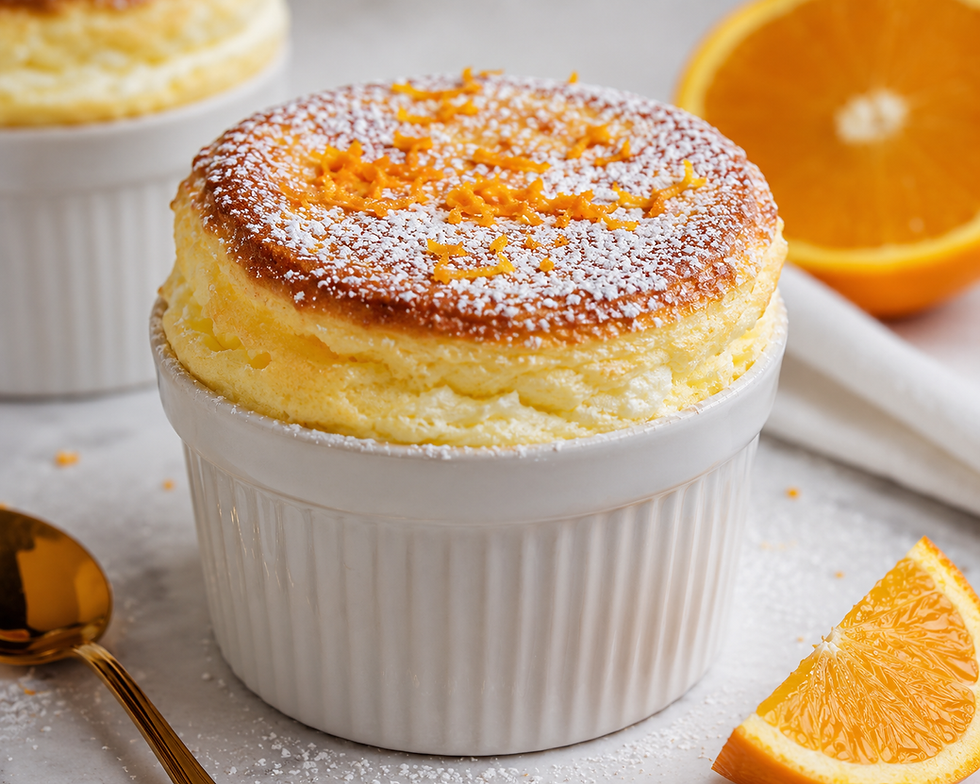
Peel the collars away while the soufflés are fully cold, pulling the paper outward rather than upward so the surface stays intact. If a strip drags, lay a hot knife blade flat against it for a second. What stands in front of you is a smooth cylinder of pale cream rising above the rim. Serve each in its own mould on a cold underplate with a folded napkin, or, if you used rings, slide the ring off with a palette knife and do not move the dessert again.
Press a narrow band of chopped almonds around the exposed side, a traditional finish on Italian cold soufflés and the only practical way to tidy that surface. Scatter a small tangle of candied orange julienne off centre on top, never covering it, and grate fresh zest over each dessert at the pass, since those oils fade within a minute. Nothing else is needed: a sauce would pool at the base and dull the line of the cylinder.
Professional Technique
The governing technique is the balance between three structures that must set at the same rate. Gelatin sets on cooling and is unforgiving about timing, Italian meringue holds air inside a cooked sugar shell around each bubble, whipped cream holds air in partly crystallised fat. Fold them in the wrong order or at the wrong temperature and one fails while the others are still working. The base has to be at cool room temperature, around 68°F (20°C), when the gelatin goes in: colder and it sets into visible threads on contact, warmer and it will not begin to set before the foams drain.
The cooked meringue is the second technique and it is not interchangeable with a raw one. Syrup at 244°F (118°C) poured into whipping whites takes the egg above 160°F (71°C), which makes a dessert with no baking step safe to serve, and gives a foam stable enough to sit overnight without weeping. The collar is the third, and it is structural: it turns a 5 oz (150 ml) mould into an 8 oz (240 ml) one, so its top edge must be level all the way round.
Texture and Moisture Control
Water is the enemy of every cold set dairy dessert and here it arrives from two directions. The first is the ricotta, which is why the overnight drain is not optional: whey that stays in the curd never evaporates later, so it gives a weeping set that slumps within minutes of the collar coming off. The second is the orange, which is why the juice is reduced to a quarter of its volume. Raw juice would add most of a cup of water, and its acid would curdle the base as you whisk.
The gelatin ratio is deliberately restrained. Seven grams across roughly four cups of mixture gives a cream that holds a clean edge but still breaks under a spoon. Push it to ten and you get an aspic, firm and bouncy and quite wrong. It needs its full time too: at four hours the set is rubbery at the edge and loose in the middle, while overnight it is even throughout. Serving temperature is the last control: straight from the refrigerator at 39°F (4°C) the orange barely registers, so give the dessert five to eight minutes at room temperature.
Professional Mise en Place
Almost everything here is prepared in advance. The only real constraint is that once the gelatin enters the base, folding, filling and levelling must finish in one unbroken run of about ten minutes.
Equipment and tools
Stand mixer with whisk, small heavy saucepan, sugar thermometer
Fine mesh sieve and rubber spatula for the ricotta
Six 5 oz (150 ml) ramekins or coppe, parchment or acetate strips, tape
Wide silicone spatula for folding, small offset spatula for levelling
Microplane for the finishing zest, kept at the pass
Prepared ahead
Ricotta drained and sieved, 1 day ahead, covered and cold
Orange syrup reduced and strained, up to 3 days ahead, refrigerated
Candied orange julienne cut and almonds chopped, up to 2 days ahead
Moulds collared and stacked on a tray the morning of service
The soufflés filled and set overnight, still in their collars
Service setup
Soufflés held cold with collars on until the order comes
Underplates and napkins cold, garnishes in small bowls within reach
Hot water and a clean cloth for warming the knife blade
Whole oranges held back unzested for the grate at the pass
Desserts out of the refrigerator 5 to 8 minutes before the table
Chef Tips
Buy sheep's milk ricotta if your cheesemonger carries it. It is what a Sicilian kitchen would use, sweeter and nuttier than the cow's milk tubs, and in a dessert that is never cooked there is nothing to hide behind.
Zest the oranges before you juice them and take only the coloured layer. The white pith is where the bitterness lives, and in a cold cream it comes through far more sharply than in a baked dessert.
Collar the moulds the day before and check them by standing the tray at eye height. A collar a few millimetres low on one side gives a sloping top, and nothing fixes that once the cream has set. Tape the outside only.
A tablespoon of good orange liqueur whisked into the cooled syrup reinforces the citrus without adding water or acid, and slightly lowers the freezing point. Do not exceed that, since alcohol in quantity weakens a gelatin set.
Common Mistakes
Using ricotta straight from the tub. The whey has nowhere to go in a cold dessert, so it stays in the cream and gives a set that weeps on the plate within minutes. Drain it overnight in a cheesecloth lined sieve.
Adding raw orange juice instead of the reduction. It brings water that slackens the set and acid that curdles the dairy proteins as you whisk. Reduce the juice with the zest to a quarter of its volume, cool it, and use the syrup alone.
Pouring gelatin into a cold base. Melted gelatin hitting cold ricotta seizes into fine rubbery threads that no whisking will dissolve. Bring the base to cool room temperature and temper the gelatin with a little syrup first.
Whipping a raw French meringue. Raw whites are neither safe in an unbaked dessert nor stable overnight, and they weep a thin layer of liquid at the base of every mould. Take the syrup to 244°F (118°C) and pour it into the whipping whites.
Over folding the finished mixture. Folding until no streak remains knocks out air the cold cannot put back, and the dessert sets dense rather than light. Stop at uniform, not at perfect.
Removing the collar too early. A soufflé with less than six hours in the refrigerator, or one that has stood out warm, slumps the moment the paper comes away. Peel it cold, outward rather than upward, immediately before plating.
Wine Pairing
Moscato d'Asti DOCG: Low in alcohol, gently sparkling and openly grapey, it carries just enough residual sugar to sit alongside the dessert without overtaking it. Its acidity and light bead scrub the fat of ricotta and cream from the palate, and the muscat aroma runs in the same direction as the orange zest.
Brachetto d'Acqui DOCG: A sweet, lightly sparkling red with almost no tannin, served cold: the only kind of red that belongs near a cold dairy dessert. Its rose and wild strawberry perfume adds a fruit note the plate does not otherwise have, with a little more weight than the Moscato.
Recioto di Soave DOCG: Made from dried Garganega, it is richer and more viscous than the sparkling wines but keeps a firm line of acidity under the sweetness, which stops it burying a delicate cream. Its candied citrus and almond character picks up both the candied peel and the chopped almonds.
Malvasia di Bosa DOC: The Sardinian outsider on this list and the most interesting glass of the five. Aged under a film of yeast, it brings a dry, nutty, bruised apple depth that contrasts with the dessert instead of matching it, and its saline finish resets the palate. Pour it cool, in a small glass.
Romagna Albana DOCG: In its passito form Albana gives apricot, honey and orange peel with a faintly bitter grip on the finish that comes from the grape's own phenolics. That bitterness is the useful part: it echoes the candied peel and keeps two sweet things from turning cloying.
Storage & Reheating
This dessert is never reheated, which is its advantage over the baked version. Keep the filled soufflés in their collars, covered loosely with plastic wrap that does not touch the surface, in the coldest part of the refrigerator for up to 3 days. They are best on the second day, once the gelatin has fully hydrated. Store them away from anything strongly aromatic, since fresh dairy picks up refrigerator smells quickly.
They freeze for up to 1 month. Freeze uncovered for 1 hour to firm the surface, then wrap each mould in plastic and foil. To serve, move them to the refrigerator for 4 to 5 hours still wrapped, so condensation forms on the wrapping rather than the cream, then unwrap, peel the collars and finish as usual. Do not thaw at room temperature. The components keep separately too: syrup 3 days refrigerated, candied julienne 2 weeks in a cool dry place, chopped almonds 1 week airtight, drained ricotta 24 hours.
Nutrition
Per serving, based on 6 servings:
Calories: 340 kcal
Total Fat: 18 g
Saturated Fat: 11 g
Trans Fat: 0 g
Unsaturated Fat: 6 g
Cholesterol: 60 mg
Sodium: 110 mg
Total Carbohydrates: 34 g
Fiber: 1 g
Total Sugars: 32 g
Added Sugars: 26 g
Protein: 11 g
Lactose: 4 g
Principal micronutrients: calcium, phosphorus, vitamin B12, vitamin A, riboflavin, selenium, vitamin C from the orange
These figures are estimates and shift with the ricotta you use, since sheep's milk carries appreciably more fat than cow's milk. The whey discarded during draining takes lactose and sodium with it, so the real values sit marginally lower than the raw ingredients suggest.




Comments