
Barbaresco: Storia, Nebbiolo e Abbinamenti (Italian Barbaresco Wine and Food Pairing Guide)
- 2 days ago
- 11 min read
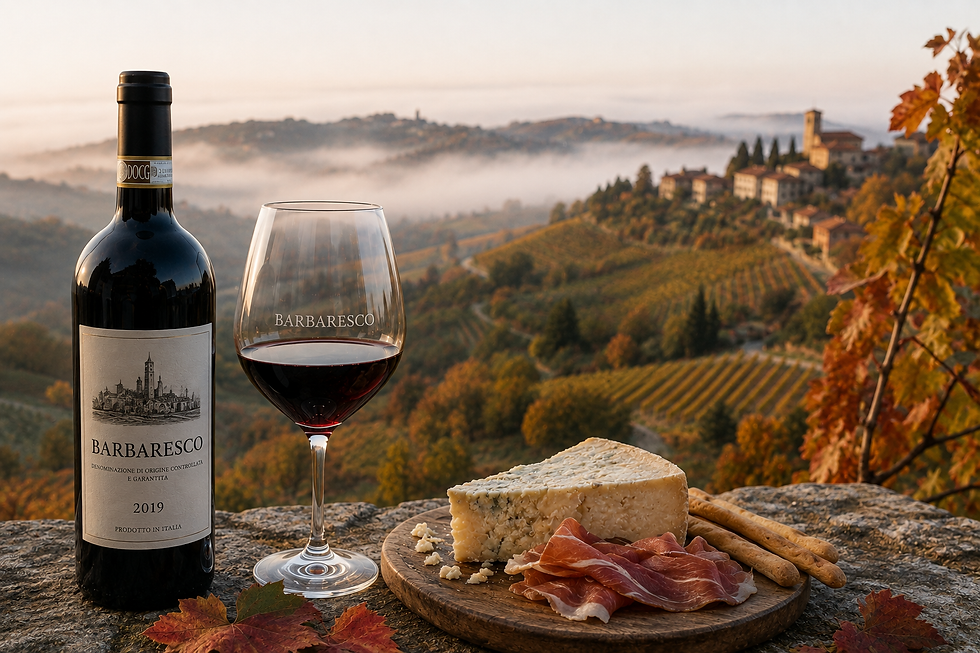
Barbaresco is one of Italy's greatest red wines.
It is also one of the most misunderstood.
Because Barbaresco and Barolo are both produced entirely from Nebbiolo in the Langhe hills of Piemonte, Barbaresco is sometimes described simply as the softer, lighter or more approachable version of Barolo.
That description is convenient.
It is also inadequate.
Barbaresco possesses its own territory, history, regulations and identity. At its best, it combines the formidable structure of Nebbiolo with extraordinary perfume, precision and elegance.
Rose.
Violet.
Red cherry.
Wild strawberry.
Orange peel.
Licorice.
Tobacco.
Leather.
Earth.
Truffle.
These characteristics can emerge and evolve over many years, transforming a young, structured wine into something profoundly complex.
And like the greatest Italian wines, Barbaresco becomes even more interesting when it reaches the table.
To understand how to pair it, however, we first need to understand where it comes from.
Barbaresco: A Small Territory with an Enormous Reputation
Barbaresco is produced in the Langhe, east and northeast of Alba in Piemonte.
The denomination is considerably smaller than many internationally famous Italian wine regions.
Its production zone centers on Barbaresco, Neive and Treiso, together with part of the municipality of Alba.
This compact geography is one of the keys to the wine's identity.
Vineyards occupy hillsides with different elevations and exposures. Soils vary from site to site. The relationship between sunlight, wind, temperature and vineyard position creates different expressions of Nebbiolo within a relatively small area.
This is why serious Barbaresco should never be understood only through the word printed in large letters on the bottle.
The vineyard matters.
The producer matters.
The vintage matters.
And increasingly, understanding the individual geographical areas matters.
Nebbiolo: 100 Percent
Barbaresco must be produced from 100 percent Nebbiolo.
No Merlot is needed to soften it.
No Cabernet Sauvignon is added to give it power.
The entire identity of the wine rests on Nebbiolo and the territory in which it grows.
Nebbiolo is one of Italy's most extraordinary grape varieties because its appearance can be deceptive.
The color is often relatively transparent compared with many powerful modern red wines.
Yet beneath that color can exist substantial tannin, high acidity and enormous aromatic complexity.
A dark wine is not automatically a powerful wine.
Nebbiolo proves that beautifully.
The Character of Nebbiolo
Young Nebbiolo can reveal aromas such as:
red cherry
raspberry
wild strawberry
rose
violet
orange peel
licorice
anise
fresh herbs
spice
As the wine matures, the aromatic profile can move toward:
dried rose
dried cherry
tobacco
leather
tea leaf
earth
mushroom
forest floor
truffle
balsamic notes
The transformation can be remarkable.
And this evolution is fundamental to food pairing.
A young Barbaresco and a mature Barbaresco should not automatically be served with the same food.
The History of Barbaresco
Nebbiolo had been cultivated in this part of Piemonte for centuries, but the development of Barbaresco as a clearly recognized wine identity took shape particularly during the nineteenth century.
One of the pivotal figures was Domizio Cavazza, an important enologist and the first director of the Royal Enological School of Alba.
At the end of the nineteenth century, Cavazza helped establish a cooperative in Barbaresco and played a major role in defining and promoting the area's wine.
The twentieth century brought periods of difficulty, including wars, economic problems and changes in agriculture.
But Barbaresco eventually emerged as one of Italy's most respected appellations.
Later, producers such as Angelo Gaja helped bring international attention to Barbaresco and demonstrated that wines from this relatively small territory could stand among the world's most serious reds.
Today Barbaresco is no longer a secret of Piemonte.
It is an international benchmark for Nebbiolo.
Barbaresco and Barolo: Understanding the Difference
The comparison is inevitable.
Both wines come from the Langhe.
Both are made from 100 percent Nebbiolo.
Both can age beautifully.
Both can show rose, cherry, licorice, leather, tobacco and truffle.
But they should not be treated as interchangeable.
Different geography, soils, exposures and mesoclimates influence the behavior of Nebbiolo.
The regulations governing maturation also differ.
Barbaresco generally reaches the market earlier than Barolo.
But the idea that Barbaresco is simply "small Barolo" should be abandoned.
Great Barbaresco can possess tremendous structure.
Great Barolo can possess extraordinary delicacy.
The real distinction comes from place and individual expression, not a simplistic hierarchy of strength.
The Villages of Barbaresco
Understanding the principal communes helps reveal the diversity of the denomination.
Barbaresco
The village that gives the denomination its name contains some of its most celebrated vineyards.
Wines can combine perfume, structure and elegance, although individual sites vary considerably.
Neive
Neive is another historic center of production.
Depending on vineyard and producer, its wines can show substantial structure, depth and aromatic intensity.
Treiso
Treiso includes vineyards at relatively significant elevations.
Many wines can display beautiful aromatic lift, freshness and elegance.
These descriptions should never become rigid rules.
Nebbiolo is too complex for that.
Producer, vintage and vineyard remain essential.
But understanding geography is far more useful than treating every Barbaresco as the same wine.
MGA: Understanding the Vineyards
Modern Barbaresco labels may carry the name of a specific Menzione Geografica Aggiuntiva, commonly abbreviated as MGA.
These officially recognized geographical mentions help identify where the grapes originate within the denomination.
For wine lovers, this opens another level of understanding.
Asili.
Rabajà.
Montestefano.
Martinenga.
Pajorè.
Ovello.
Gallina.
These are not decorative names.
They represent places.
And place is at the heart of serious Nebbiolo.
The more you explore Barbaresco, the less useful it becomes to ask simply, "What does Barbaresco taste like?"
A better question is:
Which Barbaresco?
The Structure of Barbaresco
Barbaresco combines several characteristics that make it extraordinary with food:
high acidity
significant tannin
aromatic intensity
moderate to substantial body
long persistence
This structure allows the wine to interact with rich food without relying on enormous fruit concentration.
The acidity refreshes.
The tannin responds to protein and fat.
The perfume interacts with herbs, mushrooms and truffle.
This is why Nebbiolo belongs naturally at the table.
Why Barbaresco Can Age
Acidity and tannin are two of wine's great structural preservatives.
Nebbiolo possesses both.
A well made Barbaresco from a strong vintage can develop for many years.
As it ages, the relationship between fruit, tannin and tertiary aromas changes.
Young wine may feel energetic and firm.
Mature wine can become more integrated and aromatically complex.
Eventually, the perfume can become the dominant experience.
That is when food pairing should become increasingly restrained.
Barbaresco Riserva
Barbaresco Riserva undergoes a longer required maturation period than standard Barbaresco.
But, as with Brunello and other important Italian denominations, Riserva does not automatically mean better.
Producer quality matters.
Vintage matters.
Vineyard matters.
Bottle storage matters.
A magnificent standard Barbaresco can be more compelling than an ordinary Riserva.
The label provides information.
It does not replace judgment.
The Art of Pairing Barbaresco
The pairing strategy begins with Nebbiolo's tannin and acidity.
Young wines need enough structure on the plate to absorb their firmness.
Mature wines require more delicacy because their aromatic complexity has become increasingly important.
This gives us two different approaches.
With young Barbaresco, think structurally.
With mature Barbaresco, think aromatically.
That distinction changes everything.
Tajarin al Ragù
Tajarin are one of Piemonte's great pasta traditions.
These extremely fine egg noodles possess richness from the yolks but remain delicate in texture.
With a meat ragù, they gain enough depth to work beautifully with Barbaresco.
The meat provides protein.
The pasta provides richness.
The sauce supplies savory intensity.
The wine's acidity cleans the palate while its tannin interacts with the ragù.
A younger Barbaresco is excellent here.
Now the pairing changes completely.
Fresh white truffle from Alba is extraordinarily aromatic but physically delicate.
It does not need a heavy sauce.
Butter.
Tajarin.
Truffle.
That is enough.
With a mature Barbaresco, this can become one of the great gastronomic experiences of Piemonte.
The wine's developed aromas of dried flowers, earth, mushroom and forest floor can connect with the truffle without destroying its perfume.
A very young, aggressively tannic Nebbiolo is less appropriate.
This is where bottle age matters enormously.
Agnolotti del Plin filled with roasted meats are an exceptional partner.
The filling provides protein and savory depth.
The pasta provides softness.
Butter, sage or roasting juices can provide the final bridge.
Do not drown the agnolotti in sauce.
Nebbiolo has perfume.
Give it room.
Slow cooked beef provides the collagen, protein and depth necessary for a structured young Barbaresco.
As collagen converts to gelatin, the texture of the meat becomes exceptionally compatible with tannic wine.
The sauce should remain savory.
Use vegetables, herbs and wine to build complexity.
Avoid excessive sweetness.
The Barbaresco should provide the fruit.
The sauce does not need to imitate it.
Veal cheek provides a more delicate alternative to beef cheek.
Slow cooking transforms the connective tissue into a silky texture while retaining a slightly gentler meat flavor.
This can be magnificent with Barbaresco.
The dish has enough richness for the tannin without becoming so powerful that it hides the wine's perfume.
Serve it with potato purée, polenta or a restrained root vegetable preparation.
Roast veal is one of my favorite choices for an elegant Barbaresco.
The meat is considerably more delicate than beef.
That allows the aromatic character of Nebbiolo to remain central.
Use rosemary, sage and natural roasting juices.
Keep the preparation clean.
A Barbaresco with several years of bottle development can be exceptional here.
Filet is tender but relatively lean.
For young Barbaresco, I prefer adding a savory element such as porcini or a restrained jus.
For mature Barbaresco, the simplicity of the meat becomes an advantage.
This illustrates an important principle.
The same ingredient can require a different preparation depending on the age of the wine.
Duck provides enough richness for Nebbiolo while remaining more refined than a heavy beef braise.
A Barbaresco with some maturity can work beautifully.
Use sage, rosemary or thyme.
Keep the skin crisp.
Use the natural jus.
Avoid excessive sweetness.
Nebbiolo does not need orange marmalade disguised as sauce.
Pigeon is one of the most sophisticated pairings for mature Barbaresco.
The meat has intensity, mineral character and delicacy simultaneously.
Cook the breast carefully.
Use the carcass to prepare a concentrated jus.
Add perhaps porcini or another earthy component.
Then stop.
An evolved Barbaresco can provide the rest of the complexity.
Rabbit works particularly well with a younger, elegant Barbaresco.
Garlic, rosemary, sage and olive oil provide aromatic connections without overwhelming the wine.
Rabbit does not have enormous fat.
Therefore I avoid the most aggressively tannic bottles.
Choose a Barbaresco with freshness and balance rather than sheer power.
Venison can work beautifully with a more structured Barbaresco.
The game character connects naturally with the earthy qualities of mature Nebbiolo.
Juniper and woodland herbs can strengthen the connection.
Again, avoid excessive fruit sauces.
If berries are used, they should contribute acidity and nuance rather than sweetness.
Porcini and Nebbiolo are extraordinary together.
The mushrooms provide earthiness and umami.
The wine contributes acidity, tannin and perfume.
Grilled porcini can work with a younger Barbaresco.
Risotto or tajarin with porcini can accompany something more mature.
As Barbaresco develops earthy and forest floor characteristics, the aromatic relationship becomes increasingly beautiful.
White truffle deserves separate consideration because Barbaresco may be one of its finest wine partners.
The truffle should be shaved raw over warm food.
Tajarin.
Risotto.
Egg.
Fonduta.
The heat releases the perfume.
The preparation underneath should remain relatively neutral.
A mature Barbaresco then adds rose, dried fruit, earth, tobacco and forest floor without overwhelming the truffle.
This is Piemonte speaking through both the plate and the glass.
Mushroom risotto provides creaminess, umami and aromatic depth.
Parmigiano and butter add richness.
The rice gives the dish a gentle foundation.
This can work particularly well with a Barbaresco that has begun developing tertiary complexity.
The wine's acidity prevents the risotto from becoming heavy.
Castelmagno is one of Piemonte's great cheeses.
A mature version can possess substantial intensity, salinity and complexity.
This gives it enough character for Nebbiolo.
With structured Barbaresco, the fat and protein help soften tannin.
With mature Barbaresco, the cheese's earthy complexity creates another dimension.
Serve modest portions.
Great cheese does not need to become a cheese board containing fifteen unrelated products.
Parmigiano Reggiano
Although not Piedmontese, mature Parmigiano Reggiano is excellent with Barbaresco.
Salt.
Fat.
Umami.
Crystalline texture.
All of these interact beautifully with Nebbiolo.
This is a particularly useful pairing when finishing the savory portion of dinner.
A few pieces of mature Parmigiano and the final glass of Barbaresco can be more satisfying than another complicated course.
Young Barbaresco Versus Mature Barbaresco
This is the key to pairing the wine correctly.
Young Barbaresco
Expect characteristics such as:
fresh cherry
raspberry
rose
violet
orange peel
licorice
firm tannin
high acidity
Choose foods with enough protein and richness.
Agnolotti del Plin.
Brasato.
Veal cheek.
Beef.
Duck.
Meat ragù.
Aged cheese.
The food helps manage the structure.
Mature Barbaresco
With age, the wine can move toward:
dried rose
dried cherry
tobacco
leather
tea
mushroom
forest floor
truffle
earth
integrated tannin
Now simplify.
Tajarin with white truffle.
Pigeon.
Porcini.
Roast veal.
Duck.
Aged cheese.
The pairing becomes increasingly aromatic rather than purely structural.
Barbaresco Versus Barolo at the Table
This is where the comparison between the two wines becomes useful.
If I have an extremely structured young Barolo, I may choose beef cheek, brasato or substantial game.
With an elegant Barbaresco, I can often move toward veal, duck, pigeon and truffle earlier.
But this is not a universal rule.
A powerful Barbaresco can be more structured than an elegant Barolo.
Always taste the wine.
The label gives you information.
The glass gives you the answer.
Foods to Avoid with Barbaresco
Very Spicy Food
Strong chili can exaggerate alcohol and tannin.
Sweet Sauces
Sugar can make Nebbiolo taste hard, bitter and excessively dry.
Delicate Seafood
Oysters, delicate crudo and lightly cooked white fish do not need a tannic Nebbiolo.
Aggressive Vinegar
High levels of vinegar can distort the wine's balance.
Sweet Desserts
Barbaresco is dry.
Do not serve it with chocolate cake, tiramisù or another sweet dessert simply because the wine is prestigious.
Finish the Barbaresco first.
Then move to dessert wine.
Serving Temperature
Barbaresco should generally be served around 16°C to 18°C, approximately 61°F to 64°F.
Too warm and alcohol becomes more obvious.
Too cold and tannin becomes harder while perfume disappears.
A slightly cool bottle will naturally evolve in the glass during dinner.
That is preferable to serving it warm from the beginning.
Should Barbaresco Be Decanted?
Young Barbaresco can benefit from air.
Depending on vintage and producer, decanting for approximately an hour may help reveal the wine's perfume and soften its initial impression.
Older Barbaresco requires caution.
Stand the bottle upright beforehand if sediment is expected.
Open it carefully.
Taste it.
Then decide.
A mature Nebbiolo can be extraordinarily delicate.
Do not automatically expose decades of development to aggressive aeration.
Decanting is a tool.
It is not a ceremony.
The Right Glass
Use a generous glass with a large enough bowl to allow Nebbiolo's perfume to develop.
The aromatic dimension is fundamental to Barbaresco.
Rose, cherry, orange peel, herbs, tobacco and truffle need space.
Pour modestly.
Swirl gently.
Give the wine time.
A great Barbaresco can change dramatically over the course of dinner.
Building a Piedmontese Dinner Around Barbaresco
If Barbaresco is the centerpiece, I would build the dinner around elegance rather than sheer weight.
Begin with a lighter Piedmontese wine during the antipasto.
Then introduce Barbaresco with:
Agnolotti del Plin
followed by
Guancia di Vitello Brasata
and finish the savory portion with
Castelmagno
If the Barbaresco is mature and Alba white truffle is available, I would change everything.
Serve:
Tajarin al Burro with White Truffle
followed by
Piccione Arrosto with its own jus
Then perhaps a small piece of mature cheese.
Nothing else.
A mature Barbaresco does not need a complicated menu.
It needs attention.
Chef Gianluca's Recommendation
Barbaresco is one of the wines that teaches you to stop confusing power with greatness.
Nebbiolo already gives us tannin.
It already gives us acidity.
It already gives us longevity.
What I look for in Barbaresco is what happens around that structure.
Perfume.
Precision.
Elegance.
And evolution.
With a young bottle, I let the kitchen help control the tannins.
Agnolotti.
Braised veal.
Beef.
Duck.
Aged cheese.
With an old bottle, I do almost the opposite.
I make the kitchen quieter.
Tajarin.
Butter.
White truffle.
Porcini.
Pigeon.
A simple piece of mature cheese.
The older the Barbaresco becomes, the more important its perfume becomes.
And when a wine has spent fifteen or twenty years developing rose, tobacco, dried fruit, mushroom and truffle aromas, the chef should have enough discipline not to cover them.
Barbaresco is not a smaller Barolo.
It does not need that comparison to justify itself.
It is one of Italy's great expressions of Nebbiolo, born from a small territory capable of producing wines of remarkable complexity and longevity.
Give it the correct food.
Give it the correct glass.
And above all, give it time.
Chef Gianluca Deiana


Comments