
Around Italy: Piedmont, Land of Wines and Truffles
Updated: Aug 30

Piedmont is one of the regions that best explains why Italian food cannot be reduced to a single national cuisine. In the northwest, France and Switzerland are close, the Alps shape climate and agriculture, Turin carries the memory of the House of Savoy, and the hills south of the city have become some of the most recognizable wine landscapes in Europe. The result is a regional identity built on discipline rather than excess: carefully handled meat, filled pasta, anchovies carried inland by old trade routes, hazelnuts, chocolate, mountain cheeses, long braises, elegant sweets and wines with enough structure to define an entire meal.
This guide is intentionally connected only to material already published on Zafferano & Co. Every dish named in the recipe section below links to an existing recipe on the blog, and every wine in the wine section links to an existing Piedmont wine article. That makes this page a real regional hub rather than a list of dishes and bottles that lead nowhere.
Turin: the urban heart of Piedmont
Turin is often approached too narrowly as an industrial city. That misses its deeper role. It was a political capital, a royal city, a center of publishing, manufacturing, cafés and confectionery, and it remains the most useful starting point for understanding the region. Arcades, formal squares and Baroque façades give the city an architectural order that mirrors the precision found in much of Piedmontese cooking. The Alps remain visible from the city on clear days, a constant reminder that Piedmont is both metropolitan and mountain-facing.
Food culture in Turin developed through courtly refinement and popular practicality at the same time. Chocolate and hazelnut traditions became internationally influential; breadsticks became an emblem of the city; meat cookery retained an unusually important place; and the aperitivo culture created a social rhythm that still shapes the way the city eats. The point is not that Turin invented every Piedmontese specialty, but that it concentrated, refined and commercialized many of the region’s strongest culinary ideas.
Langhe, Roero and Monferrato
South and southeast of Turin, the landscape changes into vineyard hills, small towns, castle silhouettes and farming country. The Langhe are inseparable from Nebbiolo and hazelnuts; Roero adds its own geological and viticultural identity; Monferrato extends the wine story eastward through another network of villages and historic vineyards. This is a landscape where agriculture is not decorative scenery. The vineyards, woods, orchards and livestock systems are the reason the food tastes and looks the way it does.
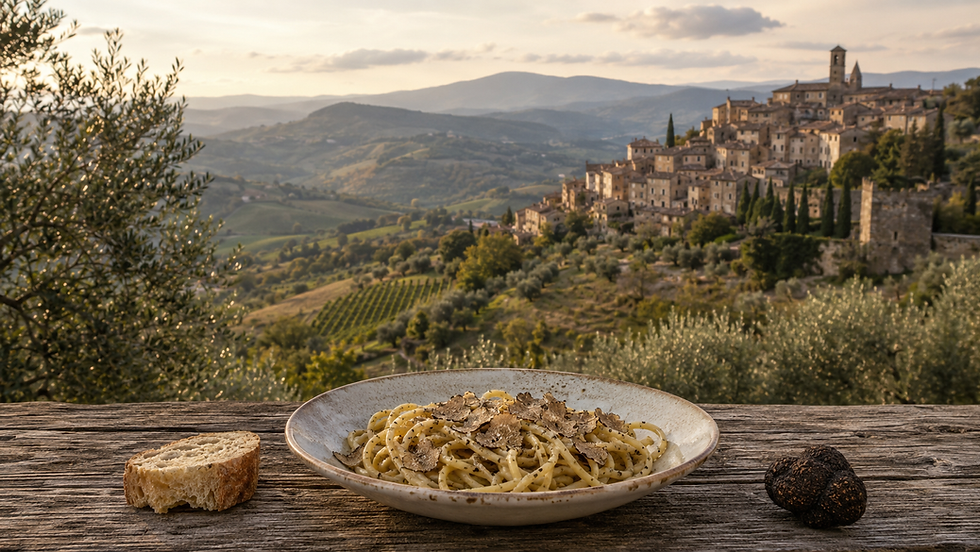
Alba is one of the best-known centers of this territory because of its white truffle culture and its position within the Langhe. Yet the larger lesson is broader: Piedmontese cooking repeatedly turns local scarcity, seasonality and preservation into sophistication. A few ingredients are handled with enough precision that the finished dish feels richer than the ingredient list suggests.
The Piedmont table — recipes already on Zafferano & Co.
The following dishes are not placeholders or outside recommendations. They are published Piedmont recipes already available on this site.
Vitello Tonnato Piemontese — one of the region’s defining cold meat preparations, built around gently cooked veal and a savory tuna, anchovy and caper sauce. The balance should be delicate: the sauce must season the veal, not bury it.
Acciughe al Verde — anchovies dressed with the region’s green sauce tradition, a reminder of the historic movement of preserved fish inland across old trade routes.
Peperoni con Bagna Cauda — sweet peppers matched with the unmistakable garlic-and-anchovy character associated with Piedmontese bagna cauda cooking.
Agnolotti del Plin — small filled pasta pinched by hand, traditionally shaped with the characteristic plin and served in a way that lets the filling and pasta remain the focus.
Finanziera Piemontese — a serious example of Piedmont’s older nose-to-tail tradition, where offal and small cuts are handled with precision rather than disguised.
Fritto Misto alla Piemontese — one of the region’s most unusual composed dishes, combining savory and sweet elements fried separately so that each component keeps its own texture.
Bollito Misto Piemontese — a ceremonial meat preparation whose quality depends on controlled poaching, correct cuts and disciplined service rather than brute richness.
Coniglio al Civet — rabbit slowly braised in red wine, representing the deeper, more rustic side of Piedmontese country cooking.
Grissini Stirati Torinesi — hand-stretched Turin breadsticks, crisp and slender, and one of the clearest edible symbols of the regional capital.
Bonet Piemontese — a chocolate and amaretti custard dessert with the compact, bittersweet profile typical of Piedmont’s historic dessert vocabulary.
Torta di Nocciole delle Langhe — a direct expression of Langhe hazelnuts, where the flavor of the nut matters more than elaborate decoration.
Baci di Dama — hazelnut sandwich cookies associated with Piedmont’s confectionery tradition and the region’s long relationship with nuts and chocolate.
Pesche Ripiene alla Piemontese — baked peaches filled with a cocoa-and-amaretti mixture, showing how the region often combines fruit, nuts, biscuits and chocolate without turning dessert into something excessively sweet.
Why Piedmontese cooking feels different
Piedmontese food is frequently richer in butter, eggs, meat and dairy than many southern Italian cuisines, but that does not mean it should taste heavy. Good execution relies on contrast: acidity against fat, bitterness against sweetness, soft fillings against firm pasta, restrained sauces against carefully cooked proteins. That is why the region’s best dishes are difficult to imitate convincingly by simply adding more cheese, butter or wine. Technique is the real source of richness.
The region also makes unusually good use of products that might seem secondary elsewhere. Anchovies become a backbone of inland sauces. Hazelnuts move from pastry into savory thinking. Breadsticks become both table bread and an ingredient. Offal becomes formal cuisine. These are not random curiosities; they are evidence of a culinary culture that learned to build identity from what trade, climate and agriculture made available.
Piedmont wines — only the regional wine articles already on Zafferano & Co.
Piedmont’s wine reputation rests on diversity as much as prestige. The links below go only to existing Zafferano & Co. wine articles from the region.
Barolo DOCG — the region’s most famous Nebbiolo expression, defined by high acidity, firm tannin, perfume and the ability to develop over time. It belongs with food that has enough depth and protein to absorb its structure.
Barbaresco DOCG — also based on Nebbiolo and capable of serious aging, but with its own geographic identity and a profile that often reaches harmony earlier than many Barolo examples.
Barbera d’Asti DOCG — naturally high in acidity and generally lower in tannin than Nebbiolo, making it one of Piedmont’s most adaptable food wines.
Dolcetto di Ovada Superiore DOCG — a dry red despite the grape’s name, valued for fruit, moderate acidity and a firmer bitter edge that works well at the table.
Brachetto d’Acqui DOCG — aromatic, lightly sparkling and sweet, particularly useful when the dessert itself has fragrance and fruit rather than only sugar.
Moscato d’Asti DOCG — low in alcohol, highly aromatic and gently sparkling, with enough freshness to keep dessert pairings from becoming cloying.
The Alps, lakes and northern Piedmont
Piedmont should not be reduced to Turin and the Langhe. The north of the region moves toward Alpine valleys, lakes and cooler viticultural areas. The food becomes more mountain-driven, the architecture changes, and the rhythm of travel slows. This is where visitors understand the geographic scale of the region: Piedmont stretches from major urban centers to vineyard hills, rice plains, foothills and high mountain landscapes.
That range is why a single weekend cannot represent the entire region. Turin deserves time on its own. The Langhe and Roero deserve a separate wine-and-food stay. Northern Piedmont deserves another journey built around mountains, lakes and small towns. Treating the region as a quick stop between Milan and France means missing the very thing that makes it distinctive.
How to approach Piedmont as a food traveler
Start with the geography, then eat accordingly. In Turin, focus on the city’s historic food culture and pastry tradition. In the Langhe, let the vineyards, hazelnuts and seasonal products guide the day. In rural areas, choose dishes that reflect the local agricultural economy rather than hunting for a generic list of famous Italian foods. Piedmont rewards travelers who pay attention to place.
The same rule applies to wine. Do not order a famous bottle simply because the label is prestigious. Match the wine to the food, the season and the pace of the meal. The best regional experience is not the most expensive one; it is the one in which the dish, the wine and the landscape make sense together.
Final perspective
Piedmont is one of Italy’s clearest examples of regional identity built through continuity. Royal history, Alpine geography, vineyard culture, preserved fish routes, livestock, hazelnuts, chocolate, filled pasta and structured wine all meet here without becoming one-dimensional. The region can be refined without being showy and rustic without being crude. That balance is the reason Piedmont remains so important to serious Italian cooking.
Use this page as the regional starting point, then follow the linked Zafferano & Co. recipes and wine articles to go deeper. Every recipe and every wine named in those sections is already part of the blog, so the guide now functions as an internal map of Piedmont rather than a disconnected overview.
Chef Gianluca
Territory Before Tourism
Piedmont should be read first through geography: Turin, Alpine valleys, Langhe vineyards, Monferrato hills, rice plains and lake districts. This physical structure explains far more than scenery. It shaped transport, agriculture, defensive settlement, market towns, cooking and even the pace of social life. A traveler who understands the territory can read a menu, a village street or a vineyard with much greater accuracy. The purpose of an Around Italy guide is to make those connections visible instead of presenting isolated attractions. When moving through Piedmont, pay attention to how quickly ingredients, architecture and local habits change as altitude, coastline or agricultural land changes. Those differences are the substance of regional Italy.
Food as Regional Evidence
The core food vocabulary includes tajarin, agnolotti, bagna càuda, vitello tonnato, brasato, hazelnuts and chocolate. These foods are valuable not because they are famous, but because they reveal what local people historically had available and how they learned to preserve, transform and serve it. A serious food itinerary should include a market, bakery or producer in addition to restaurants. Observe how bread is used, which fats dominate, whether sauces are based on meat, vegetables or fish, and how seasonality changes the menu. When a preparation appears repeatedly across villages, that repetition is evidence of a regional system rather than coincidence.
Wine and the Table
Wine should be approached with the same regional logic. Important references here include Barolo, Barbaresco, Barbera, Dolcetto and Roero. The best pairings are usually local because the food and wine evolved within the same agricultural environment. Rather than chasing the most expensive bottle, compare a regional wine with the dishes it traditionally accompanies. Acidity, tannin, salinity, bitterness and richness make more sense at the table than in an isolated tasting. A winery visit is especially useful when it includes discussion of soil, altitude, exposure and local grape varieties.
What to See and Why
A useful route includes Turin, Alba, a Langhe village, a winery, a rice-growing area and a mountain or lake destination. These stops should not be treated as equal boxes to check. Choose one or two anchors each day and allow the movement between them to reveal the landscape. A small road through olive groves, a market town at midday or a hill village near sunset can be as important as a major monument. If a place is famous, arrive early or stay late enough to experience it outside peak visitor hours. The strongest regional itineraries create contrast between city and countryside, coast and interior, archaeology and everyday life.
How to Move
The practical transport strategy is rail in and around Turin and a car for vineyard country. Italy can look compact on a map while still requiring significant travel time, particularly in mountainous or rural areas. Avoid planning days that depend on perfect traffic, parking or ferry connections. If driving, group destinations geographically and leave time for unplanned stops. If using rail, build the itinerary around stations rather than forcing rail travel onto places it does not serve well. The goal is not maximum distance. The goal is enough time in each place to understand it.
Season and Rhythm
The strongest general period is autumn for truffles and wine or spring for quieter travel, but season should be chosen according to the purpose of the trip. Harvests, food festivals, beach weather, snow, hiking conditions and religious celebrations all occur at different times. Seasonal travel also changes what appears on restaurant menus and market stalls. Morning is often best for markets and historic centers, midday for a long meal, and late afternoon for landscapes and smaller towns. This rhythm may look less efficient on paper, but it produces a much better experience on the ground.
What to Buy
Useful regional purchases include hazelnuts, chocolate, wine, cheese and regional pantry goods. Buy fewer products with better provenance. Ask where something was made, which grape or milk was used, and whether the product is actually typical of the area. Specialist food stores, farm shops, enoteche and bakeries are usually more useful than generic souvenir stores. The purchase should help preserve a memory of territory, not simply carry an Italian flag on the packaging.
A Better Three-Day Structure
Day one should establish the main city or town and its food culture. Walk the historic core, visit one major cultural site, observe a market or commercial street and eat traditionally. Day two should move outward into the agricultural or natural landscape connected to the destination. Day three should introduce contrast: a smaller community, archaeological area, coast, mountain route, vineyard or craft tradition. This center–territory–contrast model is more useful than a list of attractions because it gives the traveler a working understanding of how the region functions.
Common Mistakes
The biggest mistake is trying to see too much. The second is eating without regional context. The third is assuming that the most photographed place is automatically the most representative. Leave room for ordinary life. Do not judge every town by nightlife or every restaurant by international service expectations. Local opening hours, meal times and traditions are part of the destination. Regional travel becomes richer when the visitor adapts to the place rather than demanding that every place behave the same way.
Why This Story Matters
Piedmont matters in Around Italy because it shows the country as a collection of territories rather than a single lifestyle brand. The food, architecture, agriculture and habits described here are specific responses to history and geography. That specificity is what makes Italian regional culture so durable. A complete guide should leave the reader able to explain not only what to visit, but why the place developed the way it did.



Comments