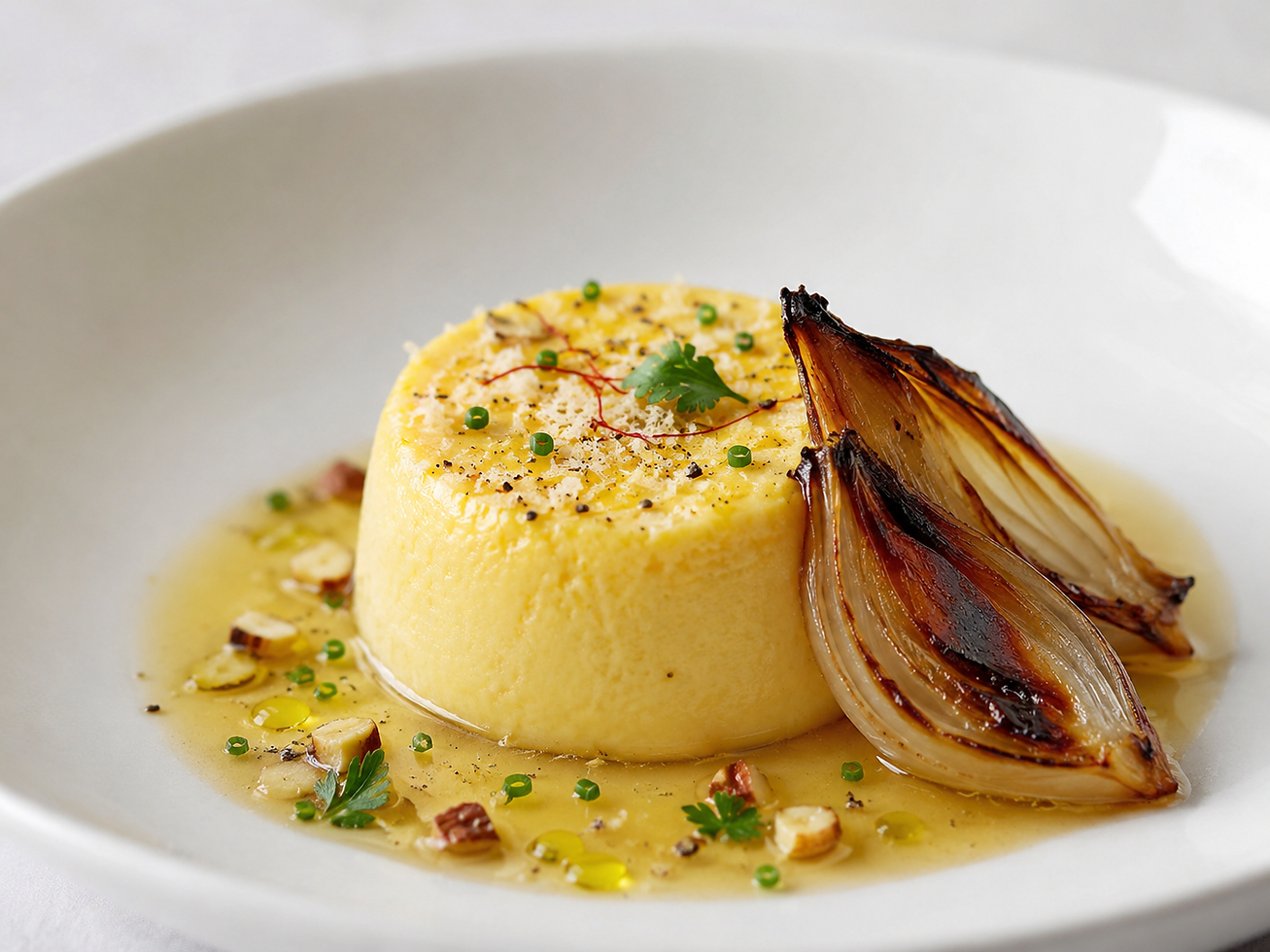
Italian Saffron Ricotta Flan | Flan di Ricotta allo Zafferano con Cipolla Arrostita, Fondo di Parmigiano e Mandorla Amara
Updated: Oct 24
A flan is a custard persuaded to stand up on its own, and everything interesting about it happens inside a narrow band of temperature. Egg proteins begin to link into a network around 145°F (63°C) and finish setting by about 180°F (82°C). Push past that and the network contracts, expels the water it was holding and leaves a grainy, weeping tortino. The water bath is what keeps the dish inside that band.
The flavour rests on four Italian things rarely put together. Sheep milk ricotta gives body and a faint lactic sweetness. Saffron runs through the custard as the connecting thread, colour and perfume at once. A whole onion roasted in its skin collapses into something dark and sweet with no sharpness left. Broth made from Parmigiano rinds supplies the savoury depth a vegetarian plate usually goes without, and coarse toasted almond is the one brittle element on a soft dish.
Yield: 6 servings. Prep: 40 minutes. Roast the onion: 1 hour 15 minutes. Bake: 35 minutes. Rest: 20 minutes. Total: about 2 hours 45 minutes. Difficulty: intermediate to advanced. Course: vegetarian main. Region: central and southern Italy, with Sardinian and Abruzzese saffron.
The Story
Saffron and ricotta meet in Italy for reasons of geography, not fashion. The two great saffron zones, the plain of Navelli in Abruzzo and the fields around San Gavino Monreale in southern Sardinia, are pastoral country where sheep were milked long before crocus was cultivated. Where there were flocks there was ricotta, made from the whey left after the pecorino, and where there was saffron it went into feast day food. Saffron scented ricotta fills Sardinian sebadas and Abruzzese baked dishes centuries before any restaurant thought of moulding it.
The flan arrives from another direction. Italy took the sformato from French court cooking in the eighteenth century and turned it into the normal way of serving a vegetable or a cheese as a course in its own right. What Italian cooks changed was the fat: French flans lean on cream, Italian ones on cheese and eggs, which is why a sformato tastes savoury where a French flan tastes rich.
The Parmigiano broth has the humblest origin of the four. Rinds were never thrown away in Emilian kitchens, they went into the minestrone pot for body and salt. Simmering them alone and straining the result is that practice taken one step further, and it gives the vegetarian equivalent of a light meat stock.
Ingredients
For the saffron ricotta flan
Sheep milk ricotta, well drained, 1 lb 2 oz (500 g)
Whole milk, 1/2 cup (120 ml)
Heavy cream, 1/4 cup (60 ml)
Saffron threads, 1/2 tsp lightly packed (0.4 g)
Large eggs, 3
Large egg yolks, 2
Parmigiano Reggiano, finely grated, 2 oz (55 g)
Fine sea salt, 1 tsp (6 g)
Freshly grated nutmeg, 1 small pinch
Freshly ground white pepper, to taste
Soft butter and fine dry breadcrumbs, for the moulds
For the roasted onion
Medium yellow onions, unpeeled, 3
Extra virgin olive oil, 2 tbsp (30 ml)
Coarse sea salt, 1 tbsp (18 g), for the tray
Thyme sprigs, 3
White wine vinegar, 2 tsp (10 ml)
Fine sea salt, to taste
For the Parmigiano broth
Parmigiano Reggiano rinds, scrubbed, 7 oz (200 g)
Water, 5 cups (1.2 l)
Shallot, halved, 1
Bay leaf, 1
Black peppercorns, 6
Unsalted butter, cold, 1 1/2 tbsp (21 g)
Fine sea salt, only if needed
For finishing
Whole blanched almonds, 2 oz (55 g)
Bitter almond extract, 2 drops, optional
Extra virgin olive oil, a few drops per plate
Saffron threads, 6, one per plate
Small thyme leaves, a few per plate
Preparation
Step 1
Draw the saffron. Warm the milk to about 150°F (65°C), take it off the heat, crumble in the threads between your fingers and leave it covered for 30 minutes. Saffron gives its colour up to warm liquid slowly and to boiling liquid badly, since heat above a simmer drives off the volatile safranal. The milk is ready when it is a strong even orange. Do not strain out the threads.
Step 2
Roast the onions whole. Heat the oven to 375°F (190°C). Leave the onions in their skins, trim only the root hairs, rub them with oil and set them on a bed of coarse salt with the thyme. Roast 1 hour 15 minutes, until they yield to a squeeze. Cooking them closed steams them in their own moisture while the sugars caramelize, removing every trace of raw sharpness. Cool, peel, discard the outer two layers and dress the chopped heart with the vinegar and salt.
Step 3
Simmer the Parmigiano broth. Put the rinds, water, shallot, bay leaf and peppercorns in a saucepan, bring to a bare simmer and hold it there 50 minutes, skimming once. The rinds soften and release gelatin and glutamate together while the liquid reduces by a third. Never let it boil, since rendered cheese fat emulsifies into a cloudy greasy broth. Strain, then taste before salting: the rind is already salty and most batches need none.
Step 4
Drain and smooth the ricotta. Sheep milk ricotta carries a great deal of whey and that water will pool in the base of the flan. Set it in a sieve over a bowl for at least 2 hours, or overnight, then press it through a fine mesh sieve. Do this by hand, not in a food processor, whose blade breaks the curd and beats in air, giving a slack gummy paste where sieving leaves a smooth base with structure.
Step 5
Build the custard. Whisk the eggs and extra yolks just until homogeneous, without beating in air, then whisk in the saffron milk and the cream. Fold this into the ricotta in three additions, then fold in the Parmigiano, salt, nutmeg and white pepper and pass the mixture once through a fine mesh sieve. The two extra yolks are deliberate, since yolk lecithin sets softer than white, which sets rubbery.
Step 6
Fill the moulds and set the water bath. Butter six ramekins of about 5 fl oz (150 ml) and dust them with dry breadcrumbs, which gives the flan something to climb and releases it cleanly. Fill them to three quarters and tap each on the bench to release trapped bubbles. Stand them in a deep roasting tin lined with a folded towel, so they do not sit on hot metal, and pour in boiling water to reach halfway up the sides.
Step 7
Bake below the setting point. Bake at 300°F (150°C) for 30 to 35 minutes. Water cannot climb beyond 212°F (100°C), so the outside never races ahead of the centre. Move the tin gently to test: the edge should be set and the centre should wobble as one piece rather than ripple. A probe at the centre should read 172 to 176°F (78 to 80°C).
Step 8
Toast the almonds and finish the broth. Toast the almonds at 325°F (165°C) for 8 to 10 minutes, until pale gold, then cool and chop them coarse and uneven. Ground almond turns to a soft meal in the broth, while coarse pieces still crack under the tooth. Bring the strained broth to a simmer, take it off the heat and whisk in the cold butter in two pieces. It emulsifies into the gelatin already there and gives the broth the gloss of a sauce.
Plating
Rest the baked flans in their water bath, out of the oven, for 20 minutes. Carryover heat finishes the centre and the structure firms enough to survive being turned out. Run a thin knife around each ramekin, set a warm plate over it and invert in one movement. If the flan hesitates it is stuck at the base, and a few seconds on a warm damp cloth releases it.
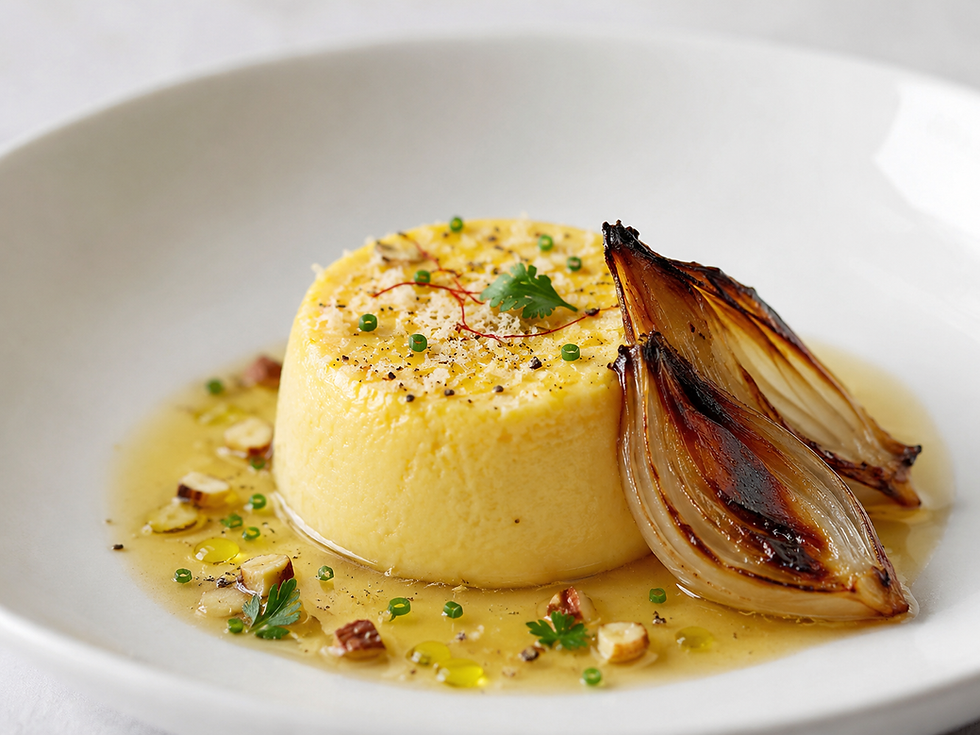
Warm the plates to about 120°F (50°C), no hotter. A cold plate takes the edge off a warm flan within a minute and a very hot one keeps cooking the base. Set the flan slightly off centre and spoon the onion in a loose pile beside it, not on top, where its moisture would soften the surface.
Pour the broth around the flan, never over it, to a depth of a few millimetres, so it pools and the saffron colour stays clean against it. Scatter the almond over the onion and around the edge of the broth, then finish with a few drops of olive oil, two thyme leaves and one saffron thread on the flan.
Professional Technique
The controlling technique is low temperature protein coagulation, and the water bath enforces it. Whole egg begins to set at roughly 145°F (63°C) and is firm by 180°F (82°C), and the window between is where a custard is silky. In a dry oven the outside of a ramekin reaches 300°F (150°C) while the centre is still cold, so the edge curdles before the middle sets. Surrounded by water, every surface of the mould stays near 200°F (93°C) and the whole flan crosses the setting range together.
The second technique is treating the ricotta as a solid. Ricotta is not a curd cheese but a whey precipitate, loose protein aggregates that hold water mechanically rather than chemically. That water escapes the moment they are heated or agitated, which is why undrained ricotta gives a flan sitting in a puddle. Draining and sieving remove the free water first, so the egg does the setting and the ricotta only contributes body.
The third is the extraction of glutamate from the rinds. Aged Parmigiano holds a very high concentration of free glutamate formed as its proteins break down during ripening, and much of it sits in the rind. Simmering pulls it into solution with enough collagen to give the broth viscosity, and below a boil the fat stays trapped in the rind instead of emulsifying.
Texture and Moisture Control
Four textures have to arrive together: the flan trembling and smooth, the onion soft and sweet, the broth glossy and fluid, the almond brittle. The flan fails only by overcooking, and the symptoms are a domed rather than flat surface, small bubbles at the edge and a bead of clear liquid on the plate a minute after unmoulding. All three mean the protein network contracted and expelled water, and none can be corrected.
Moisture control starts two hours before the oven, with the ricotta in a sieve. It can shed a quarter of its weight in whey, and whey still present at mixing has nowhere to go except the base of the mould. The onion is the second risk: roasted in its skin it holds a great deal of liquid, so drain the chopped heart and dress it at the last moment.
The broth needs viscosity, not thickness: reduced too far it turns sticky, too thin it disperses under the flan. Aim for a liquid that faintly coats a spoon. Hold it around 150°F (65°C) and never boil it after the butter, or a ring of oil appears on the plate.
Professional Mise en Place
Everything except the unmoulding and the saucing is done ahead.
Equipment and tools
Six ramekins of about 5 fl oz (150 ml), deep rather than wide
Deep roasting tin and a folded kitchen towel for the water bath
Digital probe thermometer, the single most useful item here
Fine mesh sieve, one for the ricotta and one for the broth
Balloon whisk, flexible spatula, small ladle for the broth
Prepared ahead
Parmigiano broth, up to 3 days ahead, strained and refrigerated without the butter
Roasted onions, up to 2 days ahead, peeled and chopped, refrigerated undressed
Ricotta drained overnight in a sieve set over a bowl
Almonds toasted and chopped on the day, kept in a sealed jar
Saffron milk infused and kept cold, up to 1 day ahead
Service setup
Flans baked and rested, at room temperature or rewarmed in a low water bath
Broth at about 150°F (65°C), butter whisked in only at the last minute
Onion drained and dressed, almonds within reach, plates warming to about 120°F (50°C)
Thin knife and a warm damp cloth beside the pass for unmoulding
Olive oil, thyme and the six saffron threads portioned on a small tray
Chef Tips
Buy sheep milk ricotta if you can, from somewhere that sells it fresh. Cow milk ricotta gives a milder flan, but industrial tubs are stabilized with gums that behave unpredictably under heat. If that is all you have, drain it twice as long and add one extra yolk.
Crumble whole threads rather than using saffron powder, the most adulterated spice on the shelf, routinely cut with turmeric or safflower and giving colour without perfume. Crushing threads into warm milk also releases more than dropping them in whole.
Start collecting Parmigiano rinds now and freeze them in a bag. You need 7 oz (200 g) here, more than most households have at once. Scrub them under cold water before simmering to remove the ink and the wax.
If the flans are baked ahead, rewarm them in their ramekins in a water bath at 250°F (120°C) for 12 minutes, never in a microwave, which curdles the outside while the centre is cool.
Common Mistakes
Baking without a water bath. The flan meets dry oven heat, the outside passes 190°F (88°C) long before the centre sets, and you get a rubbery ring around a liquid middle. No oven temperature is low enough to compensate.
Boiling the saffron milk. Safranal, the compound carrying the aroma, is volatile and leaves with the steam while the bitter picrocrocin stays behind. Warm the milk to 150°F (65°C), take it off the heat and give it half an hour.
Using ricotta straight from the tub. The whey it is packed in has to come out first, or it separates during baking and leaves a watery layer at the base that collapses the flan when it is turned out.
Judging doneness by time. Ramekin thickness, oven calibration and starting temperature shift the result by minutes. A probe reading of 172 to 176°F (78 to 80°C) at the centre is the only reliable test.
Boiling the Parmigiano broth. Above a simmer the rind fat emulsifies into the liquid, the broth turns cloudy and greasy, and skimming will not bring it back. Salt only at the end, since the rinds give up plenty of their own.
Wine Pairing
Franciacorta DOCG: The most complete answer to a dish this soft. Bottle fermentation gives fine persistent bubbles that scrub the ricotta fat and the butter mounted broth off the palate, and lees ageing leaves a bready note beside the toasted almond. Choose a Brut over an Extra Brut, since a few grams of residual sugar meet the sweetness of the onion.
Verdicchio dei Castelli di Jesi Classico Riserva DOCG: A Riserva has the weight this plate needs without oak in the way. Verdicchio finishes on a bitter almond note that picks up the garnish directly, its acidity cuts the rind broth, and the extra year in bottle brings a waxy texture that matches the flan.
Fiano di Avellino DOCG: The volcanic whites of Irpinia carry a smoky hazelnut and beeswax character that runs alongside saffron, since both are aromatic rather than fruity. There is real texture here, enough for a custard, and a mineral finish that keeps the plate from feeling heavy.
Collio Friulano DOC: Friulano is built on the two things this dish needs, a savoury herbal edge and a bitter almond finish, and has more body than its pale colour suggests. The herbal note lands on the thyme and the onion, while the salinity of the Collio hills answers the glutamate in the broth.
Offida Pecorino DOCG: A high acid Marche white with unusual structure for its weight and a faintly aniseed finish. That acidity is the working part of the pairing, resetting the palate after each spoonful of emulsified broth, the element most likely to build up and dull the dish.
Storage & Reheating
Stored apart, the components hold far better than the assembled plate. The baked flans keep in their ramekins, covered with film, for 2 days in the refrigerator, the broth 4 days and always before the butter goes in, the roasted onion 3 days undressed and the almonds a week in a sealed jar.
Rewarm the flans in their moulds in a water bath at 250°F (120°C) for 10 to 12 minutes, until the centre reads about 140°F (60°C). A microwave curdles a set custard in seconds and a dry oven dries the surface into a skin. Bring the broth back to a simmer, then whisk in fresh cold butter off the heat rather than rescuing the old emulsion.
The flan does not freeze: ice crystals rupture the protein network and it thaws into a grainy mass that weeps liquid. The broth freezes very well for 3 months without its butter, so it is worth making double, and the roasted onions freeze well once peeled.
Nutrition
Per serving, based on 6 servings:
Calories: 385 kcal
Total Fat: 27 g
Saturated Fat: 13 g
Trans Fat: 0.4 g
Unsaturated Fat: 13 g
Cholesterol: 205 mg
Sodium: 690 mg
Total Carbohydrates: 13 g
Fiber: 2 g
Total Sugars: 7 g
Added Sugars: 0 g
Protein: 23 g
Lactose: 4 g
Principal micronutrients: calcium, phosphorus, vitamin A, riboflavin, vitamin B12, vitamin E, magnesium, selenium, zinc
These figures are estimates. Sodium is the least predictable, since almost all of it comes from the rinds.


Comments