
Capesante Scottate con Crema di Mais Dolce, Aragosta al Burro e Uova di Salmone Seared Scallops with Sweet Corn Cream, Butter Poached Lobster and Salmon Roe
- 5 days ago
- 10 min read
Updated: 20 hours ago
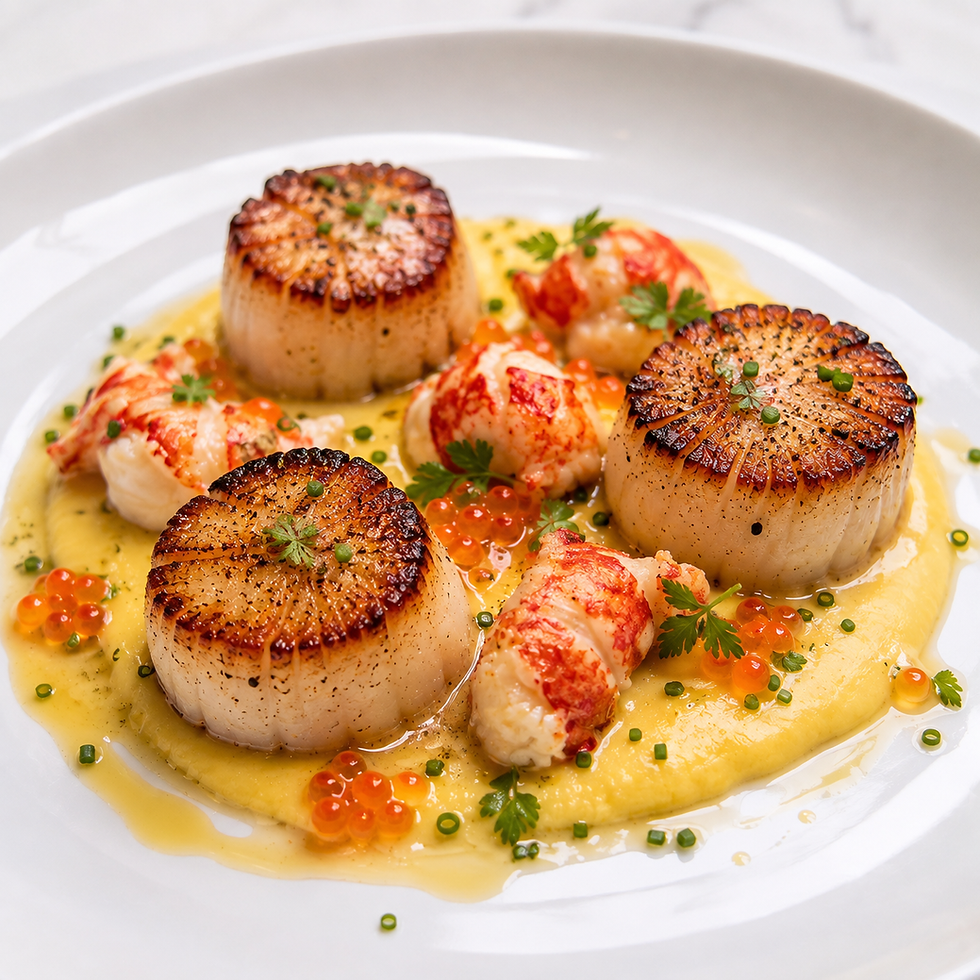
Capesante Scottate con Crema di Mais Dolce, Aragosta al Burro e Uova di Salmone Seared Scallops with Sweet Corn Cream, Butter Poached Lobster and Salmon Roe
Seared Scallops with Sweet Corn Cream, Butter Poached Lobster and Salmon Roe
Story of the Dish
Capesante Scottate con Crema di Mais Dolce, Aragosta al Burro e Uova di Salmone Seared Scallops with Sweet Corn Cream, Butter Poached Lobster and Salmon Roe
Serves: 4
Introduction
This final dish brings together scallops and lobster in a preparation that is luxurious but still technically restrained.
Sea scallops, lobster, and fresh sweet corn all possess natural sweetness. For that reason, the dish cannot rely on richness alone. Acidity and salinity are essential to create balance.
The sweet corn cream provides the foundation. Butter poached lobster contributes richness and an exceptionally tender texture. The scallops provide natural caramelization and a slightly firmer bite. Salmon roe introduces bursts of salinity that interrupt the sweetness of the shellfish and corn.
A light white wine butter sauce brings the components together, while fresh lemon provides the acidity necessary to keep the entire preparation clean.
The final plate should contain exactly three scallops per guest. Their natural golden crust should remain completely visible, with pieces of lobster arranged between them and the salmon roe used as a precise seasoning rather than an excessive garnish.
Ingredients
For the Scallops
12 large dry sea scallops, preferably U10
1 tablespoon extra virgin olive oil
1 tablespoon unsalted butter
Kosher salt, as needed
Freshly ground white pepper, as needed
For the Butter Poached Lobster
2 lobster tails, approximately 6 to 8 ounces each
8 tablespoons unsalted butter
2 tablespoons water
1 small thyme sprig
1 strip fresh lemon peel
Kosher salt, as needed
For the Sweet Corn Cream
4 ears fresh sweet corn
1 small shallot, thinly sliced
1 tablespoon unsalted butter
½ cup light shellfish or vegetable stock
¼ cup heavy cream
1 teaspoon fresh lemon juice
Kosher salt, as needed
White pepper, as needed
For the White Wine Butter Sauce
½ cup dry white wine
1 small shallot, very finely minced
½ cup light shellfish stock
4 tablespoons cold unsalted butter, cut into small cubes
1 to 2 teaspoons fresh lemon juice
Kosher salt, only if necessary
For Finishing
2 ounces high quality salmon roe
2 tablespoons finely sliced fresh chives
Fresh lemon zest, used very sparingly
1 tablespoon excellent extra virgin olive oil
Maldon sea salt, only if necessary
Mise en Place
Remove the corn kernels from the cobs.
Reserve the cobs.
Finely slice the shallot for the corn cream.
Finely mince the shallot for the white wine sauce.
Remove the lobster meat carefully from the shells.
Reserve the shells for stock.
Cut the lobster meat into substantial medallions.
Remove the lateral muscles from the scallops if necessary.
Dry the scallops thoroughly.
Keep them refrigerated uncovered on absorbent paper.
Keep the salmon roe refrigerated until the final seconds before plating.
Prepare the corn cream and white wine reduction before beginning the final cooking of the lobster and scallops.
1. Prepare the Corn Stock
After removing the kernels, cut the corn cobs into smaller pieces.
Place them in a saucepan with approximately 2 cups water or light vegetable stock.
Bring to a gentle simmer.
Cook approximately 15 to 20 minutes.
The cobs contain considerable corn flavor and natural sweetness.
This simple extraction creates a more flavorful liquid for the corn cream without requiring excessive dairy.
Strain.
Reserve approximately ½ cup for the corn cream.
Any remaining liquid can be reserved for another preparation.
2. Prepare the Sweet Corn Cream
Melt the butter in a saucepan over medium low heat.
Add the sliced shallot.
Cook gently for approximately 3 minutes.
Do not brown the shallot.
Add the fresh corn kernels.
Cook for approximately 3 minutes, stirring occasionally.
Add the reserved corn stock.
Bring to a gentle simmer.
Cook approximately 4 to 5 minutes.
The corn should become tender without losing its fresh flavor.
Add the heavy cream.
Cook for another 1 to 2 minutes.
Remove immediately from the heat.
3. Blend the Corn Cream
Transfer the corn mixture to a high speed blender.
Blend at maximum speed until completely smooth.
Add the lemon juice.
Season carefully with kosher salt and white pepper.
Pass the cream through a fine mesh sieve.
Do not skip this step.
The outer skins of corn kernels remain fibrous even after powerful blending.
Passing the cream through a sieve transforms the texture from a rustic corn purée into a refined sauce.
The finished consistency should be thick enough to hold a controlled spoon stroke on the plate while remaining silky and fluid.
Keep warm at approximately 140°F to 150°F.
Do not boil after blending.
4. Prepare the Lobster
If using raw lobster tails, remove the meat carefully while keeping it as intact as possible.
Cut each tail into approximately 4 to 6 substantial medallions, depending on size.
The pieces should remain recognizable as lobster.
Do not dice the meat into small cubes.
Season extremely lightly with kosher salt.
Remember that the salmon roe will provide significant salinity during final plating.
5. Prepare the Beurre Monté
Place 2 tablespoons water in a small saucepan over low heat.
When the water is warm, add approximately 1 tablespoon butter.
Whisk continuously.
Once the first piece has emulsified, begin adding the remaining butter gradually.
Continue whisking.
The objective is to create a stable mixture of water and butterfat rather than simply melting a stick of butter.
Add the thyme sprig and lemon peel.
Maintain the beurre monté between approximately 160°F and 175°F.
Do not allow it to boil.
6. Butter Poach the Lobster
Place the lobster medallions into the beurre monté.
The butter should surround most of the lobster.
Maintain gentle heat.
Cook approximately 4 to 6 minutes, depending on the thickness of the pieces.
Turn them occasionally.
The lobster should become opaque while remaining exceptionally tender.
Avoid aggressively cooking the lobster until it becomes firm and rubbery.
Remove the lobster from the beurre monté.
Transfer to a warm tray.
Spoon a very small amount of the butter over the lobster to prevent the surface from drying.
Keep warm for only the short period required to finish the scallops.
Understanding Beurre Monté
Ordinary melted butter separates into butterfat, water, and milk solids.
Beurre monté is different.
By beginning with a small amount of water and gradually whisking in butter at controlled temperature, the butter remains emulsified.
This creates an exceptionally gentle cooking medium.
Instead of frying the lobster in hot fat, the beurre monté transfers heat gradually and surrounds the meat with a rich but controlled environment.
Temperature is critical.
If the beurre monté becomes excessively hot, the emulsion can break and the lobster can overcook rapidly.
7. Prepare the White Wine Reduction
Place the finely minced shallot and white wine in a small saucepan.
Bring to a simmer.
Reduce until approximately 2 tablespoons liquid remain.
Add the shellfish stock.
Continue reducing until approximately one third of the liquid remains.
Taste.
The reduction should be concentrated and aromatic without becoming aggressively salty.
8. Finish the White Wine Butter Sauce
Remove the saucepan from the heat.
Allow it to cool for approximately 20 to 30 seconds.
Begin whisking in the cold butter one cube at a time.
Do not add the next cube until the previous one is almost completely incorporated.
Add the lemon juice.
Taste.
Adjust the acidity if necessary.
The sauce should be glossy, light, and noticeably fresher than the sweet corn cream.
Do not return it to a hard boil after mounting with butter.
Keep warm.
9. Prepare the Scallops
Remove the scallops from refrigeration approximately 10 minutes before cooking.
Dry them again thoroughly using fresh paper towels.
Their surfaces should contain virtually no visible moisture.
Season lightly with kosher salt immediately before cooking.
Do not season heavily.
The salmon roe will provide the final saline component.
10. Sear the Scallops
Place a heavy stainless steel or cast iron skillet over medium high to high heat.
Allow the pan to become thoroughly hot.
Add the olive oil.
When the oil begins shimmering, place the scallops into the skillet.
Leave generous space between them.
Do not move them.
Do not press them.
Cook approximately 1½ to 2 minutes on the first side.
The surface should develop natural golden brown caramelization.
Turn each scallop once.
Add the butter.
Tilt the skillet.
Baste the scallops with the foaming butter for approximately 30 to 45 seconds.
Remove immediately.
The sides should remain ivory and the centers moist and tender.
The seared surface should look naturally irregular.
There should be no artificial grill lines.
11. Handle the Salmon Roe Correctly
Keep the salmon roe refrigerated until the plate is almost complete.
Do not cook it.
Do not stir it into the hot corn cream.
Do not incorporate it into the butter sauce.
The roe should remain intact so each egg produces a distinct saline burst when eaten.
Think of the roe as both seasoning and texture.
Two ounces for four portions is sufficient.
More is not necessarily better.
Flavor Architecture
This preparation contains several naturally sweet ingredients.
The scallop is sweet.
The lobster is sweet.
Fresh corn is sweet.
Butter reinforces richness.
For that reason, the dish requires counterpoints.
The white wine contributes acidity.
The lemon sharpens the sauce.
Salmon roe contributes salinity.
Chives provide fresh aromatic character.
The dish succeeds when those contrasting elements prevent the sweet ingredients from becoming monotonous.
Michelin Style Plating
Use a large warm white plate.
Place approximately 2 tablespoons sweet corn cream slightly off center.
Using the back of a spoon, create a smooth, controlled oval or short sweep.
Arrange three scallops per person across the corn cream.
Keep every naturally caramelized surface facing upward and completely visible.
Place two or three pieces of butter poached lobster between the scallops.
Do not stack the lobster on top of the scallops.
Spoon a restrained quantity of white wine butter sauce around the composition.
Do not pour it over the caramelized scallop surfaces.
Add several small spoonfuls of salmon roe between the lobster and scallops.
Do not place roe on every component.
Finish with finely sliced chives.
Add an extremely small amount of fresh lemon zest.
Finish with several drops of excellent extra virgin olive oil if necessary.
The final presentation should remain low, elegant, and natural.
Avoid tall garnishes.
Avoid excessive microgreens.
Avoid covering the plate with salmon roe.
The luxury of the presentation should come from the quality of the ingredients rather than excessive decoration.
Restaurant Service Method
The corn cream can be prepared before service and held warm.
Keep it covered to prevent a skin from forming.
The white wine reduction can be prepared before service, but mount it with cold butter closer to plating.
The lobster can be removed from its shell and portioned before service.
Prepare the beurre monté shortly before firing the dish.
Portion three scallops per guest.
Keep them refrigerated on absorbent paper.
Keep the salmon roe refrigerated.
When an order is fired, gently reheat the corn cream.
Begin butter poaching the lobster.
Warm the white wine reduction and complete the butter emulsion.
Begin searing the scallops so they finish shortly after the lobster.
Plate the corn cream first.
Add the scallops and lobster.
Finish with the white wine butter sauce.
Add the salmon roe only during the final seconds.
The dish should leave the pass immediately.
Chef’s Technical Notes
Use fresh corn whenever possible. Its natural sweetness and aroma are fundamental to the dish.
Extract flavor from the corn cobs. They contain considerable flavor that should not be wasted.
Pass the corn cream through a fine sieve. This is essential for a refined texture.
Do not use excessive cream. The sauce should taste primarily of corn.
Keep the beurre monté below a boil. Temperature control protects both the emulsion and the lobster.
Do not overcook the lobster. The texture should remain tender and succulent.
Mount the white wine sauce off the heat. This helps maintain a stable butter emulsion.
Dry the scallops thoroughly. Surface moisture prevents proper caramelization.
Keep the scallop crust natural. Real pan caramelization is slightly irregular.
Never bury the seared scallop surface under sauce. Protect the crust.
Never cook the salmon roe. Add it at the final moment.
Taste before adding finishing salt. The salmon roe already contributes substantial salinity.
Wine Pairing
Franciacorta Satèn DOCG
This is my first choice for the dish.
The fine bubbles and creamy texture work beautifully with lobster, scallops, corn, and butter.
At the same time, the acidity refreshes the palate and prevents the richness from becoming excessive.
Vermentino di Gallura DOCG
A structured Vermentino provides Mediterranean salinity and acidity that complement both shellfish preparations while contrasting naturally with the sweet corn.
Etna Bianco DOC
Carricante offers mineral tension and bright acidity.
This is particularly useful against the richness of beurre monté and the natural sweetness of corn.
Alta Langa DOCG
A traditional method Alta Langa provides acidity, complexity, and enough structure to accompany the lobster without overwhelming the scallops.
Chef Gianluca’s Recommendation
This is the richest plate in the scallop series, which means restraint becomes more important, not less.
You already have scallops, lobster, butter, corn, and salmon roe.
You do not need another six ingredients to prove that the dish is luxurious.
Make the corn cream exceptionally smooth.
Poach the lobster gently enough that it remains tender.
Sear the scallops aggressively enough to create natural caramelization without overcooking their centers.
Then use the salmon roe sparingly.
The perfect bite begins with the sweetness of corn and scallop.
The lobster adds richness.
The salmon roe suddenly breaks that sweetness with a burst of salinity.
Finally, the white wine and lemon acidity clean the palate.
Use exactly three beautiful scallops per guest, keep the lobster between them, and leave enough negative space on the plate for every ingredient to be clearly understood.
Luxury comes from precision, not excess.
Recipe Information
Servings: 4. Prep Time: about 20 minutes. Cook Time: about 20 minutes. Total Time: about 40 minutes.
Wine Pairing
Moscato d'Asti: aromatic sweetness supports the dessert without overwhelming it. Brachetto d'Acqui: red-fruit perfume works well with fruit, chocolate, and cream-based desserts. Vin Santo: nutty oxidative notes complement baked and almond-based preparations. Passito di Pantelleria: concentrated fruit and acidity pair with richer desserts. Recioto di Soave: balanced sweetness and freshness suit custards, cakes, and semifreddi.
Nutrition per Serving
Approximate nutrition per serving: 430 calories, 0.25 oz protein, 1.83 oz carbohydrates, 0.78 oz fat, 0.46 oz saturated fat, 0.07 oz fiber, 1.2 oz sugars, 170 mg sodium, and 95 mg cholesterol. Values vary with portion size and exact ingredients.
Storage and Reheating
Store covered in the refrigerator according to the most perishable ingredient, generally up to 3 days. Frozen preparations should remain tightly wrapped to prevent ice crystals and odor absorption. Temper briefly before serving when needed for the intended texture.


Comments